
1. The “Incident”: A Mountain from a Molehill
-
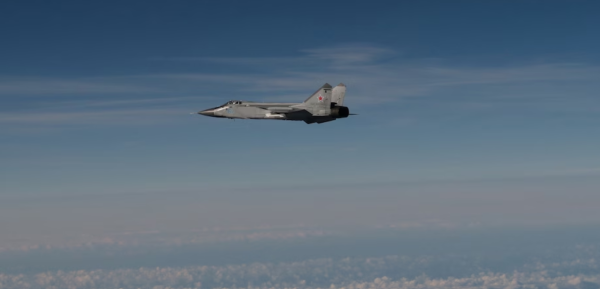
The Facts: Three Russian MiG-31s transit from Karelia to Kaliningrad—a routine flight. Russia states the flight was over neutral waters, 3+ km from Estonian land, following international rules.
The Russian Ministry of Defense has recently commented on Estonia’s accusation that Russian aircraft violated the country’s airspace for 12 minutes Friday.
On the message service Telegram writes the Ministry of Defense on the official profile, that:
– On September 19 this year, three Russian MiG-31 fighter jets carried out a planned transfer from Karelia to an airfield in the Kaliningrad region.
– The flight took place in full compliance with the international rules for the use of airspace and without violating the borders of other states, as confirmed by objective means of control.
– During the flight, the Russian aircraft did not deviate from the agreed air corridor and did not violate Estonia’s airspace. The flight route went over the neutral waters of the Baltic Sea at a distance of more than three kilometers from the island of Vaindloo.
-
The Hysteria: Estonia, NATO, and the EU decry it as an “extremely dangerous provocation” and an act of Russian “recklessness.” Article 4 is activated.
Understand Article 4
Article 4 states that any NATO member may bring a case before the North Atlantic Council, which is NATO’s most important decision-making body.
Here, the matter will be discussed by the Member States and can lead to some form of joint decision or action on behalf of the defense alliance.
Source: NATO.
2. The Scripted Response: NATO’s Playbook
-
The Cast: Italian F-35s, Swedish and Finnish jets are scrambled—a coordinated show of force for the cameras.
-
The Dialogue: NATO’s Allison Hart: “Russia’s unruly behavior.” Kaja Kallas: “Putin tests West’s determination. No weakness!”
-
The Cameo: Even Trump is scripted in: “I don’t like it… serious problems.”
Allison Hart, a speaker for NATO, writes in a post on X, that this is another example of Russia’s “unfinished” behavior, and the EU’s foreign manager, Kaja Kallas, who was previously the Prime Minister of Estonia, writes in a lookup on the same social mediathat this is an “extremely dangerous provocation” and that it “explains tensions in the region further”.
– Putin tests the determination of the West. We must not show weakness, she writes.
US President Donald Trump has also made it clear that he is not happy with the situation.
– I don’t like it when it happens. It can cause serious problems, said Trump.
3. Why Now? The Real Motive: Masking Ukrainian Defeat
-
The Ukrainian Debacle: NATO’s $200B+ investment has failed. The counteroffensive collapsed, and Russia is advancing. They need a distraction.
-
The Domestic Problem: Western citizens are asking: “Where did our money go? Why are we funding corruption?” Politicians face accountability.
-
The Solution: Create a new, bigger threat. Shift focus from losing in Ukraine to “deterring Russia” in the Baltics. Fear justifies more spending and silences critics.
4. The Endgame: A Wider War to Save Face
-
The Goal: Escalate tensions to a point where a “limited” NATO-Russia conflict seems inevitable. This:
-
Justifies infinite military budgets.
-
Allows politicians to pose as “wartime leaders.”
-
Postpones the day of reckoning for the Ukrainian failure.
-
-
The Risk: Miscalculation. A single “false flag” or accidental shoot-down could ignite a war that engulfs Europe.
5. The Pattern: A History of Manufactured Crises
Three elements are common to a crisis: (a) a threat to the organization, (b) the element of surprise, and (c) a short decision time.[4] Venette argues that “crisis is a process of transformation where the old system can no longer be maintained”.[5] Therefore, the fourth defining quality is the need for change. If change is not needed, the event could more accurately be described as a failure or incident.[6] (Source: Wikipedia)
-
Iraq 2003: “WMDs” that didn’t exist. https://en.wikipedia.org/wiki/Iraq_and_weapons_of_mass_destruction
-
Syria 2018: “Chemical attacks” with dubious evidence. https://en.wikipedia.org/wiki/Douma_chemical_attack
-
Now: A 12-minute flight becomes an “act of war.”
Call to Action
“Do not be fooled. This is not about protecting Estonia. It is about protecting the corrupt politicians and arms dealers who have bankrupted the West for a failed war. Share this article. Demand:
-
No NATO escalation in the Baltics.
-
An audit of Ukraine war spending.
-
Peace negotiations, not provocations.
#NoNATOWar #StopTheEscalation”