Posted on Leave a comment

The Sydney Attack: Beyond Anti-Semitism, a Spiral of Collective Guilt and Impunity

Introduction:
The deadly attack on a Jewish community celebrating Hanukkah in Sydney was, unequivocally, an act of anti-Semitic terrorism. To state otherwise is to dishonor the victims. However, as this analysis argues, our understanding cannot stop at this necessary condemnation. To treat this violence merely as the product of individual extremism is politically convenient but critically inadequate. The attack is a terrifying symptom of a deeper global malaise: the normalization of collective guilt, fueled by systemic impunity and a catastrophic failure of international justice.

The normalization of collective guilt, fueled by systemic impunity and a catastrophic failure of international justice.

The Normalization of Collective Guilt
A critical starting point is the dangerous erosion of individual responsibility in public discourse. When phrases like “there is no innocence in Gaza” or “no innocent Israeli” enter political and media language, guilt is transferred from actors to identities. This logic of collective sin is inherently transferable. Once legitimized against one group, it can be directed at any other.

In this context, the lack of clear, continuous, and collective distancing from Israeli state crimes by large, established Jewish institutions worldwide holds particular political weight. Regardless of intention, this silence is rarely read as neutrality. In the face of systematic violence, perceived moral ambiguity is often interpreted as passive complicity. This blurring of lines between state policy, collective identity, and individual responsibility creates a perilous ideological fog.

When phrases like “there is no innocence in Gaza” or “no innocent Israeli” enter political and media language, guilt is transferred from actors to identities

The Engine of Impunity and Political Despair
Simultaneously, the international community has proven itself unwilling or unable to act. Israeli actions have, in practice, been met with impunity. Palestinians are killed daily without effective political or legal response from the institutions created to uphold international law. The result is not merely a legal collapse, but a profound and growing political despair.

This despair rarely finds coherent political mobilization. When channels for accountability and justice are blocked, anger tends to erupt in diffuse and misdirected forms. From this perspective, it is tragically unsurprising that violence erupts in places like Australia, targeting the wrong people in a distorted expression of rage. We consistently underestimate how long-term, unpunished brutality poisons communities far beyond the conflict’s geographical epicenter.

line drawing of ouroboros - a snake eating its own tail
Never ending circularity

The Vicious Cycle: How Misdirected Violence Fuels the Very System It Opposes
Anti-Semitic attacks achieve no legitimate political goal. They do not aid Palestinians nor challenge the structures enabling Israeli abuses. Their primary impact is to reinforce pre-existing racialized threat narratives, particularly Islamophobic ones.

This leads to a vital, often overlooked consequence: Rising Islamophobia in the West fosters more reflexive, unconditional support for Israel. As Muslim communities are portrayed as civilizational threats, Israeli state violence is framed as necessary “self-defense”—even when it meets the legal criteria for war crimes. Thus, a coherent, vicious pattern emerges:

  1. Impunity for state violence breeds despair.

  2. Despair fuels misdirected violence.

  3. This misdirected violence reinforces racist frameworks (Islamophobia, anti-Semitism).

  4. These frameworks are then used to justify the original impunity.

 

Conclusion: Breaking the Spiral Requires Clear Distinctions
Breaking this spiral demands more than condemning individual attacks. It requires steadfast moral and analytical clarity. We must insist on the distinctions that nihilistic violence and cynical politics seek to erase:

  • Between a government and its people.

  • Between political responsibility and ethnic or religious identity.

  • Between legitimate criticism of a state and racial or religious hatred.

Without these distinctions, violence does not subside; it metastasizes. Honoring the victims in Sydney—and in Gaza—requires us to confront this toxic ecosystem of guilt and impunity with unflinching courage and precision. The path to safety for all lies not in tribal consolidation, but in the rigorous defense of universal justice and individual humanity.


Dispersive prism - Wikipedia
The clarity we need: to separate the blinding glare of violence into the distinct truths it contains.
twitterlinkedininstagramflickrfoursquaremail
Posted on Leave a comment

Exploiting Tragedy: How the Sydney Attack is Used to Reinforce the “Victim” Narrative

Introduction:
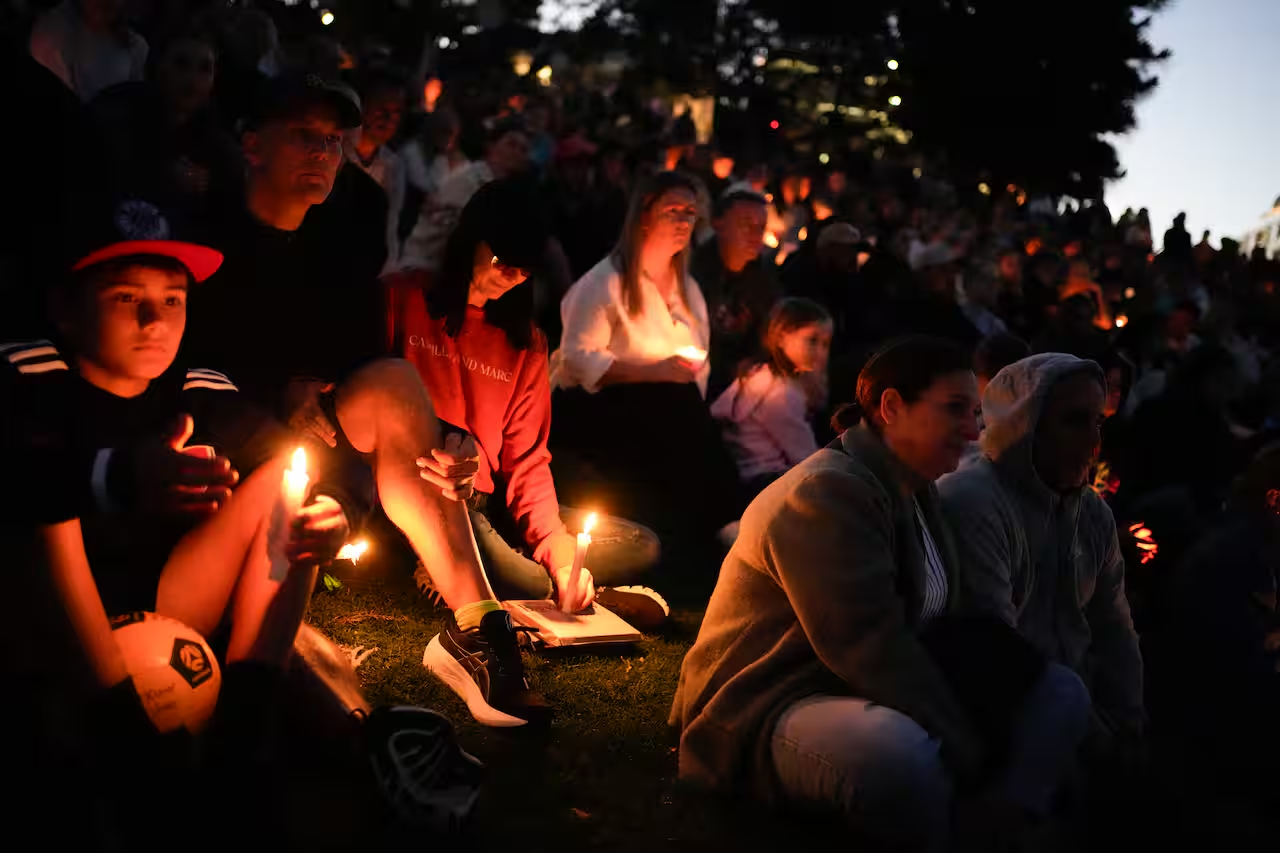
The tragic shooting in Sydney, Australia, which occurred during a Hanukkah celebration, has rightly been met with international condemnation and grief. However, beyond the immediate human tragedy, a complex political narrative is rapidly unfolding. This analysis examines how this event outside of Palestine is being instrumentalized to reinforce a longstanding political narrative: framing the Israeli state as a perpetual “victim” to deflect from its actions in Gaza and the occupied territories.

framing the Israeli state as a perpetual “victim” to deflect from its actions in Gaza and the occupied territories.

The Immediate Narrative Shift: From Occupation to “Anti-Semitism”
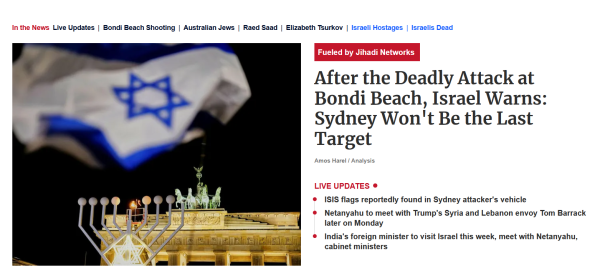
In the immediate aftermath, Israeli media outlets prominently framed the attack not as an isolated criminal or terrorist act, but as a symptom of “rising global anti-Semitism.” As Palestinian-Israeli affairs expert Ali Al-Awar notes, this coordinated media focus serves a symbolic purpose. By placing the incident within this specific context, it reinforces a core element of Zionist political discourse: that Israel and Jews worldwide are under constant, existential threat, thereby positioning the state in the role of the oppressed.

Israeli Prime Minister Benjamin Netanyahu’s response followed this script, broadly linking the attack to anti-Semitism without addressing specific political contexts. This framing is strategic, aiming to universalize the conflict and obscure its particular roots in the occupation of Palestine.

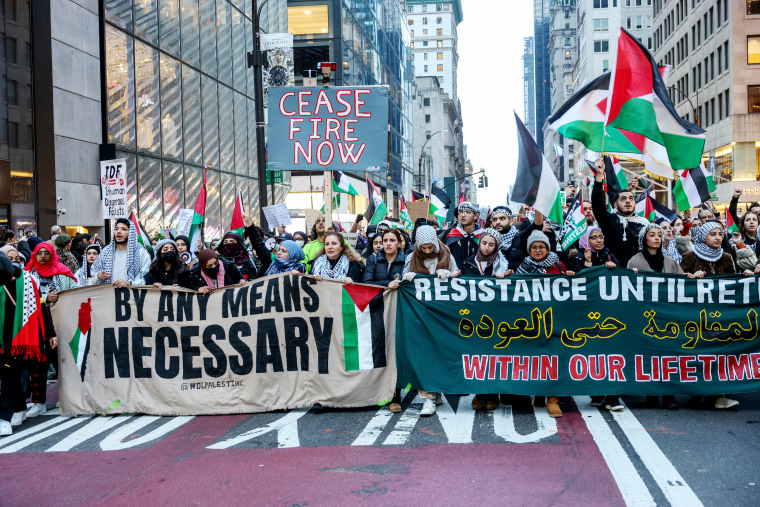
Who's behind the pro-Palestinian protests in the U.S.?
The Immediate Narrative Shift: From Occupation to “Anti-Semitism”

Political Utility: Diverting Attention and Applying Pressure
The exploitation of this tragedy serves multiple political aims for the Israeli government:

  • Diverting Global Attention: As journalist Fayez Abu Shamaleh points out, the attack provides a powerful new imagery to divert global public opinion from the devastating war in Gaza. Netanyahu can use these images in international forums to shift the conversation.

  • Stifling Diplomatic Moves: The “anti-Semitism” discourse is leveraged to pressure governments like Australia’s, potentially deterring them from actions like recognizing a Palestinian state by conflating such political stances with hatred toward Jews.

  • Internal Political Divide: The attack exacerbates a rift within Israeli society. One faction sees Netanyahu’s aggressive policies in Gaza and Lebanon as inflaming global anger and endangering Jews abroad, while his supporters use the event to double down on the siege mentality and consolidate domestic support.

    red fake news warning sign 11702828 PNG
    The exploitation of this tragedy serves multiple political aims for the Israeli government

Skepticism and Alternative Narratives
The swift politicization has also bred significant public skepticism. On social media, voices have questioned the official narrative, with some pointing to historical conspiracies (like the King David Hotel bombing) to suggest the attack could be a “false flag” operation designed to garner sympathy. While such claims are extreme and often lack evidence, their circulation highlights a deep global distrust in official Israeli narratives following the Gaza war.

Furthermore, observers and Islamic bodies like Australia’s Council of Imams have been quick to make crucial distinctions: they condemn attacks on civilians anywhere while warning against using this tragedy to “purify the image of the occupying Power.” They, along with Palestinian resistance groups, emphasize that their struggle is political—against Zionism and occupation—not religious or aimed at Jewish people outside of Palestine.

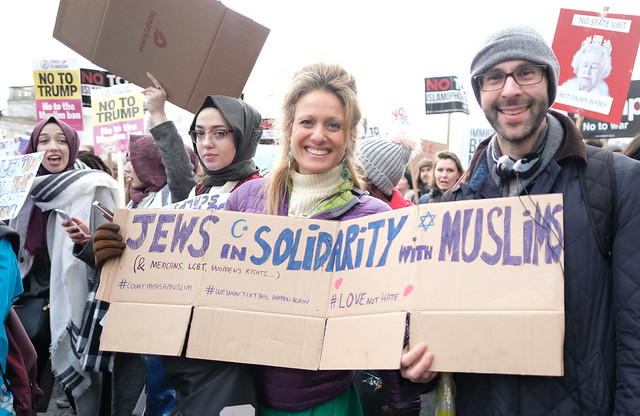
“Jews in solidarity with Muslims (and Mexicans, LGBT, womens’ rights…)”—placard on the anti-Trump Muslim ban march in London. Photo Credit: Alisdare Hickson

Conclusion: A Tragedy Within a Tragedy
The Sydney attack is a profound tragedy for the victims, their families, and the Australian Jewish community. Its exploitation for political purposes constitutes another layer of tragedy. When a horrific act of violence is immediately funneled into a pre-existing propaganda framework to justify further violence elsewhere, it corrupts the memory of the victims and poisons the well of international discourse. True solidarity requires mourning the dead in Sydney without letting their deaths become a tool to obscure the deaths of thousands in Gaza. The path forward must be built on honest confrontation with root causes, not the cynical reproduction of victimhood narratives. Interfaith solidarity initiatives Images - Free Download on Freepik


twitterlinkedininstagramflickrfoursquaremail