Posted on Leave a comment

A Geopolitical Tool, Not a State: Israel’s Recognition of Somaliland

Israel’s recognition of the breakaway region of Somaliland is not a benign diplomatic gesture. It is a calculated move in a long-term strategy of regional destabilization. This analysis argues that Tel Aviv’s action should be seen as a deliberate attempt to weaken national structures, create new crisis points, and extend its geopolitical reach into the strategically vital Horn of Africa and Red Sea corridor, all while disregarding the fundamental principles of international law.

Members of the IDF General Staff look over a map during the outbreak of the Yom Kippur War on October 17, 1973. (Micky Astel/Bamahane/Defense Ministry Archives)
An archival image of Israeli intelligence officials Members of the IDF General Staff look over a map during the outbreak of the Yom Kippur War on October 17, 1973. (Micky Astel/Bamahane/Defense Ministry Archives)

The Strategic Logic: Security Through Instability

Historically, Israel has often pursued a security doctrine that favors a fragmented and unstable neighborhood over strong, unified regional states. Recognizing Somaliland fits this pattern perfectly. It is not about supporting a nascent democracy but about engineering a geopolitical tool.

From a strategic viewpoint, this move is part of Israel’s effort to shift its confrontation with the Axis of Resistance (Iran and its allies) to more distant, less costly battlegrounds. The Red Sea and Bab al-Mandab Strait have become critical pressure points. By gaining a foothold in Somaliland, Israel seeks future intelligence and operational access in a region that could be decisive in containing Iranian influence and securing vital shipping lanes for its allies, primarily the United States.

The UN Charter is outdated and unfit for purpose
UN Charter: 80 years of guiding principles (https://www.un.org/en/about-us/un-charter)

[/caption]The Political Message: Normalizing DisintegrationBeyond strategy, the recognition sends a profound political message: the complete disregard for the sovereignty and territorial integrity of states. For Israel, principles like non-interference and territorial unity—cornerstones of the UN Charter—are subordinate to its immediate interests.

Just as the occupation of Palestinian territories and the violation of UN resolutions have become routine, supporting the disintegration of sovereign nations is now being normalized as a legitimate tool of Israeli foreign policy. Recognizing Somaliland is an attempt to legitimize fragmentation itself as a geopolitical tactic.

The Backfire: Isolation Instead of Legitimacy
Contrary to any hopes in Tel Aviv, this move has not bought Israel international goodwill or legitimacy. Instead, it has triggered widespread condemnation from Arab, Islamic, and African states, along with concern from international actors. The reaction underscores a critical consensus: unilateral acts of disintegration threaten regional security for all.

The fear is of a contagious “separatist pattern” that could destabilize the entire Red Sea region. Far from being a diplomatic masterstroke, Israel’s recognition of Somaliland has proven to be a costly strategic gamble that has increased its political isolation.
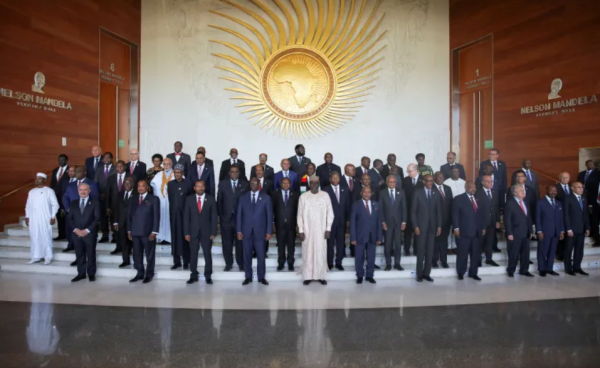
The dispute over Israel’s observer status to the bloc was set in motion in July 2021 when then-chair of the AU Commission, Moussa Faki Mahamat, accepted unilaterally the country’s accreditation [Tiksa Negeri/Reuters]
A Risky Gambit in a Fragile Region
Israel’s recognition of Somaliland is a stark illustration of a foreign policy built on the principle of “divide and influence.” It seeks short-term tactical advantage by undermining the sovereignty of Somalia and fueling regional fragmentation. However, this gambit carries significant long-term risks. By openly treating the disintegration of states as a policy tool, Israel further erodes its own standing under international law and galvanizes opposition among nations that see their own territorial integrity potentially under threat. In the fragile ecosystem of the Horn of Africa, such a move does not create a reliable ally in Somaliland; it sows the seeds for broader, unpredictable instability that ultimately threatens the security of all actors in the region.Loose Woven Stock Illustrations – 999 Loose Woven Stock Illustrations, Vectors & Clipart - DreamstimeIsrael’s recognition of Somaliland is the deliberate act of pulling at the threads of national unity

twitterlinkedininstagramflickrfoursquaremail
Posted on Leave a comment

Exploiting Tragedy: How the Sydney Attack is Used to Reinforce the “Victim” Narrative

Introduction:
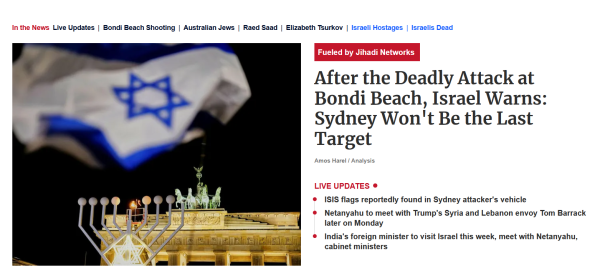
The tragic shooting in Sydney, Australia, which occurred during a Hanukkah celebration, has rightly been met with international condemnation and grief. However, beyond the immediate human tragedy, a complex political narrative is rapidly unfolding. This analysis examines how this event outside of Palestine is being instrumentalized to reinforce a longstanding political narrative: framing the Israeli state as a perpetual “victim” to deflect from its actions in Gaza and the occupied territories.

framing the Israeli state as a perpetual “victim” to deflect from its actions in Gaza and the occupied territories.

The Immediate Narrative Shift: From Occupation to “Anti-Semitism”
In the immediate aftermath, Israeli media outlets prominently framed the attack not as an isolated criminal or terrorist act, but as a symptom of “rising global anti-Semitism.” As Palestinian-Israeli affairs expert Ali Al-Awar notes, this coordinated media focus serves a symbolic purpose. By placing the incident within this specific context, it reinforces a core element of Zionist political discourse: that Israel and Jews worldwide are under constant, existential threat, thereby positioning the state in the role of the oppressed.

Israeli Prime Minister Benjamin Netanyahu’s response followed this script, broadly linking the attack to anti-Semitism without addressing specific political contexts. This framing is strategic, aiming to universalize the conflict and obscure its particular roots in the occupation of Palestine.

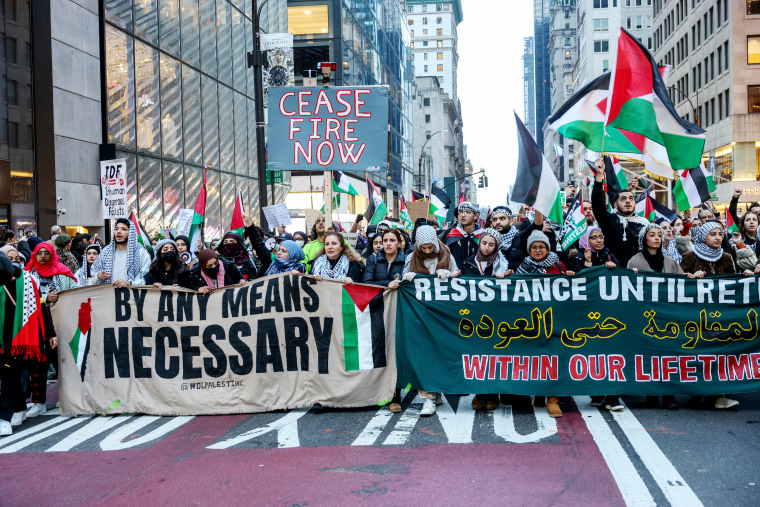
Who's behind the pro-Palestinian protests in the U.S.?
The Immediate Narrative Shift: From Occupation to “Anti-Semitism”

Political Utility: Diverting Attention and Applying Pressure
The exploitation of this tragedy serves multiple political aims for the Israeli government:

  • Diverting Global Attention: As journalist Fayez Abu Shamaleh points out, the attack provides a powerful new imagery to divert global public opinion from the devastating war in Gaza. Netanyahu can use these images in international forums to shift the conversation.

  • Stifling Diplomatic Moves: The “anti-Semitism” discourse is leveraged to pressure governments like Australia’s, potentially deterring them from actions like recognizing a Palestinian state by conflating such political stances with hatred toward Jews.

  • Internal Political Divide: The attack exacerbates a rift within Israeli society. One faction sees Netanyahu’s aggressive policies in Gaza and Lebanon as inflaming global anger and endangering Jews abroad, while his supporters use the event to double down on the siege mentality and consolidate domestic support.

    red fake news warning sign 11702828 PNG
    The exploitation of this tragedy serves multiple political aims for the Israeli government

Skepticism and Alternative Narratives
The swift politicization has also bred significant public skepticism. On social media, voices have questioned the official narrative, with some pointing to historical conspiracies (like the King David Hotel bombing) to suggest the attack could be a “false flag” operation designed to garner sympathy. While such claims are extreme and often lack evidence, their circulation highlights a deep global distrust in official Israeli narratives following the Gaza war.

Furthermore, observers and Islamic bodies like Australia’s Council of Imams have been quick to make crucial distinctions: they condemn attacks on civilians anywhere while warning against using this tragedy to “purify the image of the occupying Power.” They, along with Palestinian resistance groups, emphasize that their struggle is political—against Zionism and occupation—not religious or aimed at Jewish people outside of Palestine.

“Jews in solidarity with Muslims (and Mexicans, LGBT, womens’ rights…)”—placard on the anti-Trump Muslim ban march in London. Photo Credit: Alisdare Hickson

Conclusion: A Tragedy Within a Tragedy
The Sydney attack is a profound tragedy for the victims, their families, and the Australian Jewish community. Its exploitation for political purposes constitutes another layer of tragedy. When a horrific act of violence is immediately funneled into a pre-existing propaganda framework to justify further violence elsewhere, it corrupts the memory of the victims and poisons the well of international discourse. True solidarity requires mourning the dead in Sydney without letting their deaths become a tool to obscure the deaths of thousands in Gaza. The path forward must be built on honest confrontation with root causes, not the cynical reproduction of victimhood narratives. Interfaith solidarity initiatives Images - Free Download on Freepik


twitterlinkedininstagramflickrfoursquaremail
Posted on Leave a comment

The Great Zionist Flight: Israel’s Tax Bribes Can’t Stop the Exodus

The Zionist project is facing an unprecedented crisis: its own people are leaving. Since the Al-Aqsa Storm operation, the phenomenon of “reverse migration” has accelerated, forcing the Israeli regime to resort to financial bribes to stem the tide.

A Regime in Demographic Panic
According to the Zionist newspaper Yediot Aharonot, more than 145,900 people fled the occupied territories between 2020 and 2024—outstripping the number of new immigrants. This exodus, composed largely of former immigrants, reveals a profound disillusionment with the Zionist state.

In response, Finance Minister Bezalel Smotrich has proposed an extreme measure: a five-year tax exemption for Jews who immigrate to Israel. This desperate move—unprecedented in Israeli history—shows how deeply the leadership fears the collapse of its demographic foundation.

May be a graphic of ‎text that says '‎y net בירידה זינוק בישראל השלילי ההגירה מאזן 2023 82,800 יורדים 2021 2024 (ינו'-אוג') 49,000 יורדים 2022 59,400 יורדים 2020 34,400 34, 400 יורדים 41,400 יורדים 2020 32,500 חוזרים 2021 23, 23,600 חוזרים 2022 29,600 חוזרים 2023 24,200 24, חוזרים 2024 (ינו'-אוג') 12,100 חוזרים -145,900 :2024- 2020 השנים בין ההגירה מאזן הכול, בסך‎'‎
Note: A special report from the Knesset Research and Information Center revealed alarming figures, indicating that approximately 145,900 more Israelis left the country than returned between 2020 and 2024.

The Al-Aqsa Storm Effect
The October 7 operation shattered the myth of Israeli invincibility. As rockets rained down and resistance fighters breached the Gaza barrier, thousands of Zionists rushed to Ben Gurion Airport, booking one-way tickets out of their “homeland.” The sense of security that underpinned the colonial project evaporated overnight.

Smotrich’s tax plan is a direct admission that the Zionist state can no longer rely on ideology alone to attract and retain settlers. When fear outweighs faith, the only tool left is money.

Israel sees record passenger travel since Oct 7. as flight prices jump by up  to 119% | The Times of Israel
Israel sees record passenger travel since Oct 7. as flight prices jump by up to 119% | The Times of Israel

The Economic Consequences of Desperation
Israeli economic experts have warned that Smotrich’s plan will further strain the regime’s finances. With tax revenues already stretched by perpetual war and settlement expansion, exempting new immigrants could blow a hole in the budget.

But the Israeli cabinet seems willing to pay the price. For them, maintaining a Jewish majority in occupied Palestine is an existential priority—even if it means bankrupting the state.

May be an image of 1 person and text that says 'TRTWORLD " Israeli sovereignty will be applied to 82% of the territory [occupied West Bank] Israeli Finance Minister BezalelSmotrich Bezalel Smotrich Photo:Routors Photo: Routors'
JERUSALEM: Israel plans to use tax revenue it collects on behalf of the Palestinian Authority to pay the PA’s nearly 2 billion shekel ($544 million) debt to state-run Israel Electric Co. (IEC), the far-right Finance Minister Bezalel Smotrich said on Sunday.

A Failing Colonial Project
The Zionist flight is not new, but it has now reached critical mass. When a state must bribe its people to stay, it admits that its foundational narrative has failed. The “land of milk and honey” has become the land of anxiety and exit permits.

This exodus is the ultimate indictment of Zionism: those who were promised a safe homeland are now escaping it.

Thousands plan march to dismantled West Bank settlement over IDF's initial  objection | The Times of Israel
The “land of milk and honey” has become the land of anxiety and exit permits

Conclusion: The Unraveling
Smotrich’s tax exemptions are a temporary fix for a terminal condition. No financial incentive can erase the reality of resistance, the burden of international isolation, or the moral rot of occupation. The Zionists are voting with their feet—and their verdict is clear.

Israel's International Isolation Is Painful. But It Is Also Necessary -  Opinion - Haaretz.com

Israel’s International Isolation Is Painful. But It Is Also Necessary – Opinion – Haaretz.com

twitterlinkedininstagramflickrfoursquaremail
Posted on Leave a comment

The Price of Complicity: Unmasking America’s Role as a Partner in the Gaza War

Introduction:
The word “peace” has been a constant refrain in American diplomatic statements regarding Gaza. But when examined against the totality of evidence—the financial flows, the arms shipments, and the political support—this claim rings hollow. This article argues that the United States has shed the mantle of a neutral mediator to become an active and essential partner in building Israel’s war machine, directly fueling a conflict that has created a profound humanitarian crisis.

Notes: Military aid for Israel includes missile defense funding starting in 2006, using data from the Congressional Research Service. All other data is from foreignassistance.gov. Aid to Ukraine for fiscal years 2022 to 2024 is reported by the Kiel Institute for the World Economy as being around $16 billion higher than figures from foreignassistance.gov. South Vietnam existed as a country until the end of the Vietnam War in 1975. Data for 2024 is partially reported.

The Foundation of Support: A Long-Standing Partnership
The history of American military and financial aid to Israel is not new, but its scale and intensity during the Gaza war have reached unprecedented levels. Since 1948, the US has been Israel’s primary military patron, with billions of dollars flowing through long-term contracts. This support, often framed as ensuring an ally’s security, has in practice facilitated the continuation of violence and occupation.

This structured support was solidified in agreements like the Obama-era 10-year memorandum, guaranteeing $3.8 billion in annual military aid. However, since October 2023, the US has approved emergency aid packages pushing direct military assistance to at least $17.9 billion, with some estimates suggesting the total, including indirect support, may exceed $30 billion.

US-taxpayers file a historic lawsuit charging Washington with complicity in Gaza genocide - TRT World
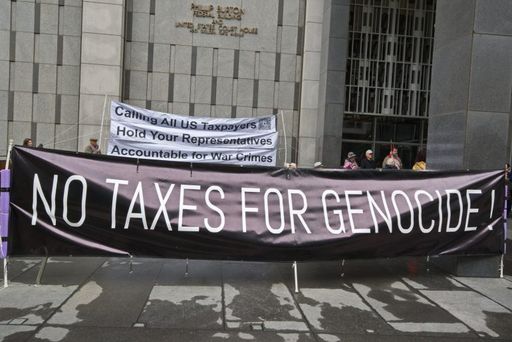
Image: no taxes for war and militarism. War tax resisters are taking to the streets to call for an end to genocide and endless war. They are divesting from the taxes that fund war and investing in people, planet, and justice. 

The American Taxpayer: Financing a Distant War
This colossal financial support does not come from a surplus; it is funded directly by American taxpayers. Statistical estimates break this down to a cost of approximately $85 to over $165 per American taxpayer. This expenditure occurs while the United States faces domestic crises in healthcare, education, and infrastructure. The equivalent funds could have provided health insurance for millions of children or hired hundreds of thousands of new teachers, revealing a stark misalignment between public need and policy priorities.

Note: Lockheed Martin is an American aerospace and defense company, formed by a merger of Lockheed Corporation and Martin Marietta in 1995. It is headquartered in North Bethesda, Maryland, and provides innovative solutions for aerospace, defense, and security challenges worldwide. The company’s main business is with the U.S. Department of Defense and federal agencies, but it also has international and commercial sales


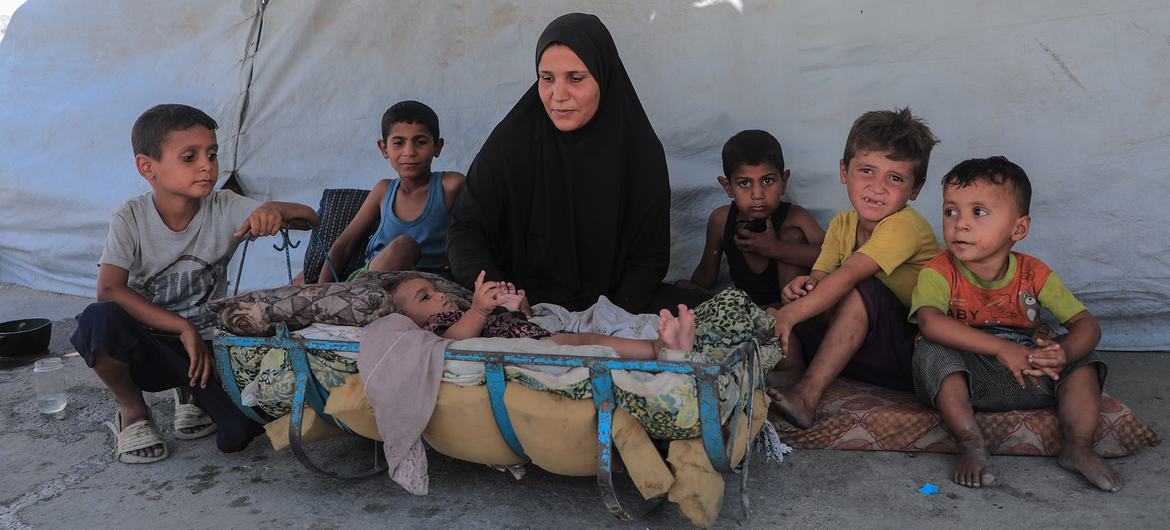
A displaced family sit in front of their tent in Gaza.
Image: UNICEF/Mohammed Nateel A displaced family sit in front of their tent in Gaza.


The War Economy: Who Really Benefits?
A critical question is: who profits from this cycle? A significant portion of US military aid is designed as a subsidy for American defense contractors. Israel is often required to spend the aid on weapons purchased from US companies like Lockheed Martin, Boeing, and Raytheon. This creates a profitable feedback loop where aid money cycles back into the pockets of American corporations, making war a lucrative business for the US’s war-oriented economy.


The Human Cost and Shifting Public Opinion
The tragic reality of this support is measured in the devastation in Gaza: thousands dead, hundreds of thousands displaced, and critical infrastructure like hospitals and schools destroyed by American-made bombs. This reality is reshaping American public opinion. Polls show a majority of younger Americans (ages 18-29) oppose continued military aid. Within the American Jewish community, movements like “Jews for Peace” are gaining traction, challenging unconditional support for the Israeli government.

Calls for a Ceasefire Get Little Traction in Congress
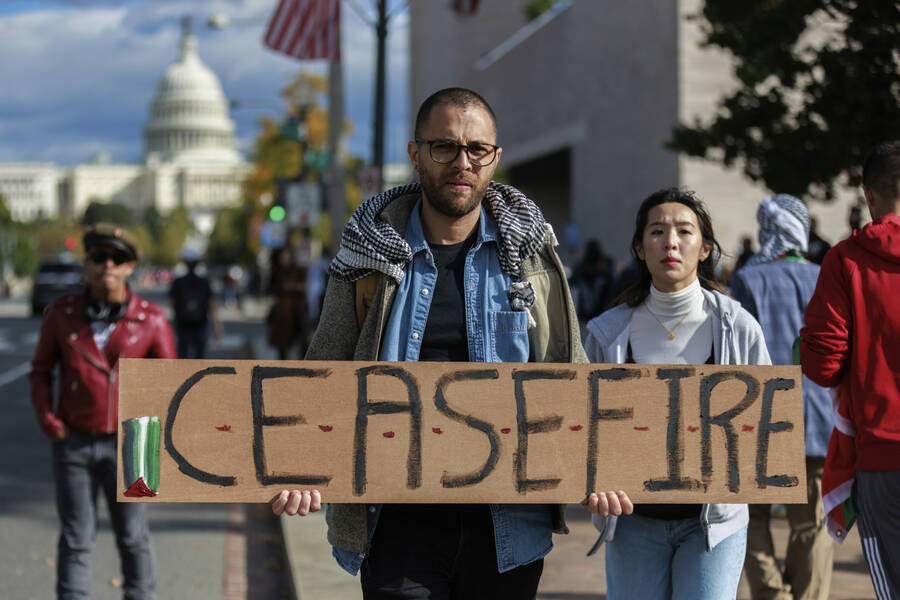
Image: Demonstrators on the National Mall in Washington, DC, call for a ceasefire in Israel’s assault on Gaza on October 21st, 2023.

Conclusion: A Partner, Not a Peacemaker
The evidence paints a clear and damning picture. The United States is not a mediator or a pacifist in the Gaza war; it is an active partner. By bankrolling the war machine with taxpayer money and ensuring the flow of arms, America has become complicit in the resulting humanitarian catastrophe. It has abdicated its claim to moral leadership on the world stage. As long as this partnership continues, American talk of “peace” will remain nothing more than a political show, a cover for a policy rooted in conflict.

2+ Thousand Make Peace Not War Royalty-Free Images, Stock Photos & Pictures | Shutterstock

twitterlinkedininstagramflickrfoursquaremail