Posted on Leave a comment

A Rival to the UN? The Global Split Over the U.S.-Led “Peace Council” for Gaza

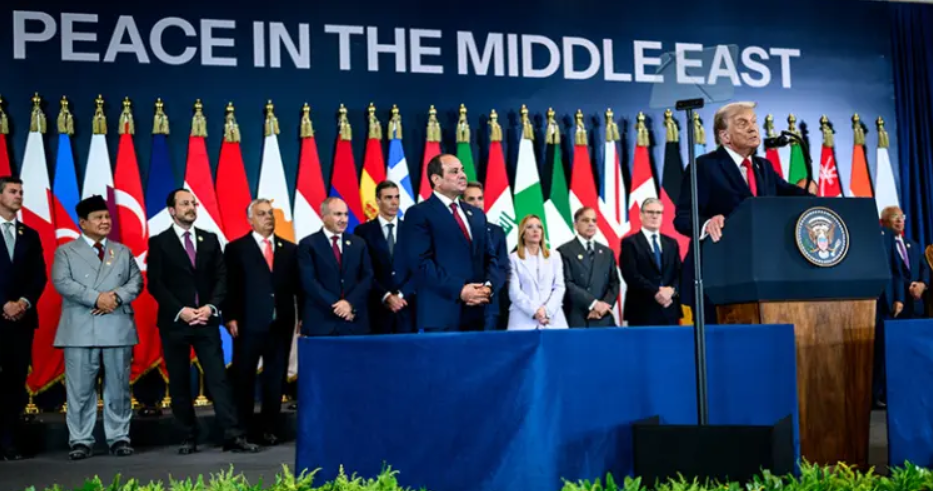
A new international body was launched in Davos this week: the “Peace Council for the Gaza Strip,” championed by the United States and signed by over a dozen countries. Yet, its birth was marked by profound absences. Neither Israel nor Palestine attended the ceremony, and four of the five UN Security Council permanent members declined to join. This initiative has ignited a critical global debate: Is this a genuine effort for peace, or an attempt to create a parallel structure that undermines the United Nations and the foundations of international law?

An exclusive signing: The Davos “Peace Council” launch, missing the key voices of Palestine and Israel

The Core Conflict: Reinventing or Replacing the Wheel?
The stated goal of the Peace Council—to resolve conflicts and guarantee peace—directly overlaps with the core mandate of the United Nations. This has raised immediate and serious doubts. Why create a new, selective body when a universal one already exists? Critics argue that bypassing the UN weakens international law and sets a dangerous precedent where powerful nations can create exclusive clubs to address issues that require global consensus. As UN Secretary-General António Guterres has stated, “The UN is more than an entity; it is a living promise.” Any mechanism seeking to sideline it struggles for legitimacy.
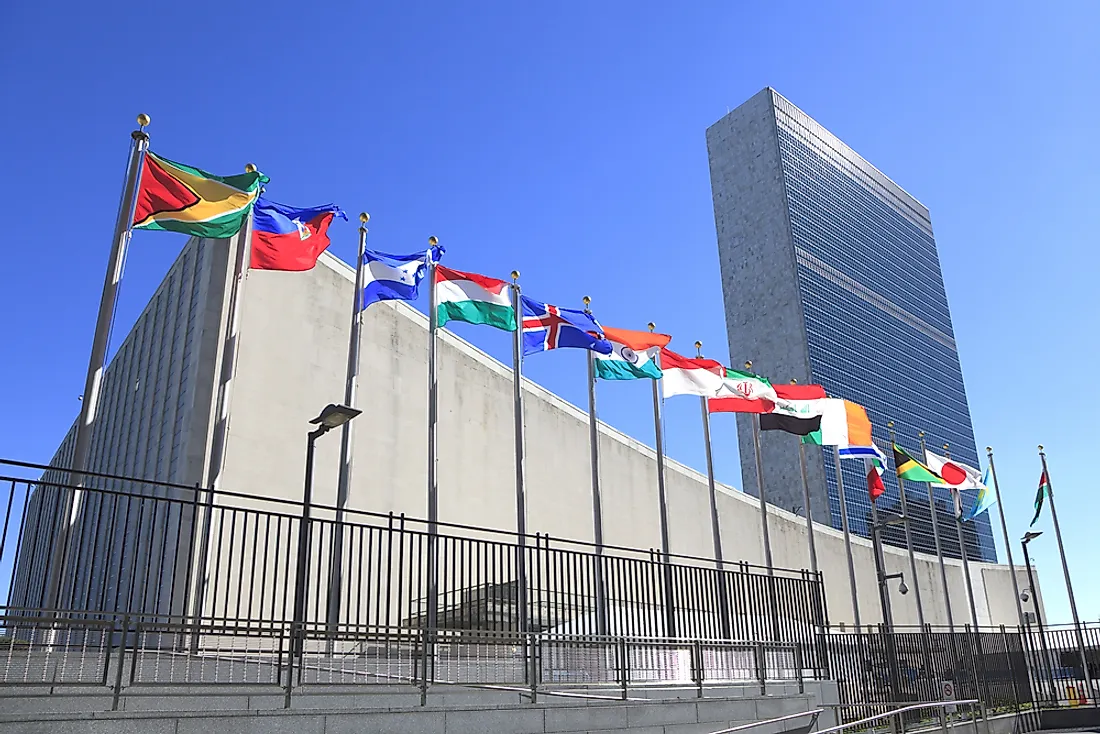
U.N.
The bedrock institution: The United Nations remains the central pillar of the post-war international order for peace and security

Global Skepticism and a Divided West
The council has failed to unify even traditional allies. Nations like France, Germany, Norway, Sweden, Denmark, and Slovenia have publicly refused to participate. Former German Foreign Minister Annalena Baerbock’s statement was blunt: “We have a peace council and that’s the UN.” This Western split reveals deep reservations about the initiative’s legitimacy and effectiveness. Furthermore, reports that large financial contributions could buy influence or even “permanent membership” have been condemned as turning peace into a commodity, contradicting the principle of sovereign equality.
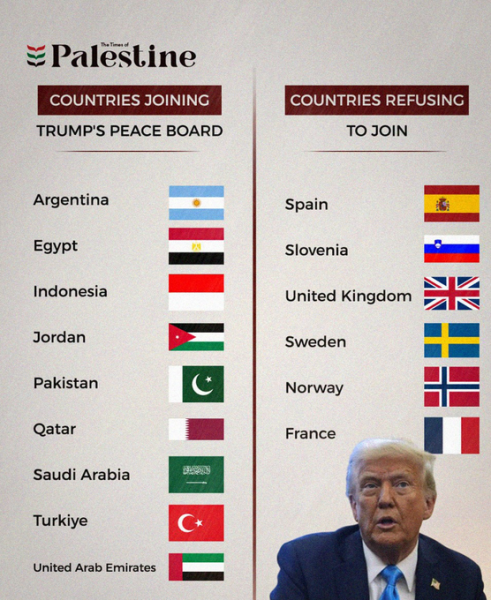
A Western split: Key U.S. allies in Europe have publicly refused to join the new council, highlighting its divisive nature

The Path to Peace: Exclusivity vs. Inclusivity
The fundamental flaw of the Davos initiative is its exclusion of the primary parties. A peace process for Gaza that does not centrally include Palestine—and ultimately Israel—is fundamentally flawed. China, in its official statements, has stressed unwavering support for the UN-centered international system and called for any solution to be examined within the UN framework with all relevant parties present. The only viable, agreed-upon path remains the full implementation of the “two-state solution.” Mechanisms that monopolize the peace process risk inflaming tensions rather than resolving them.
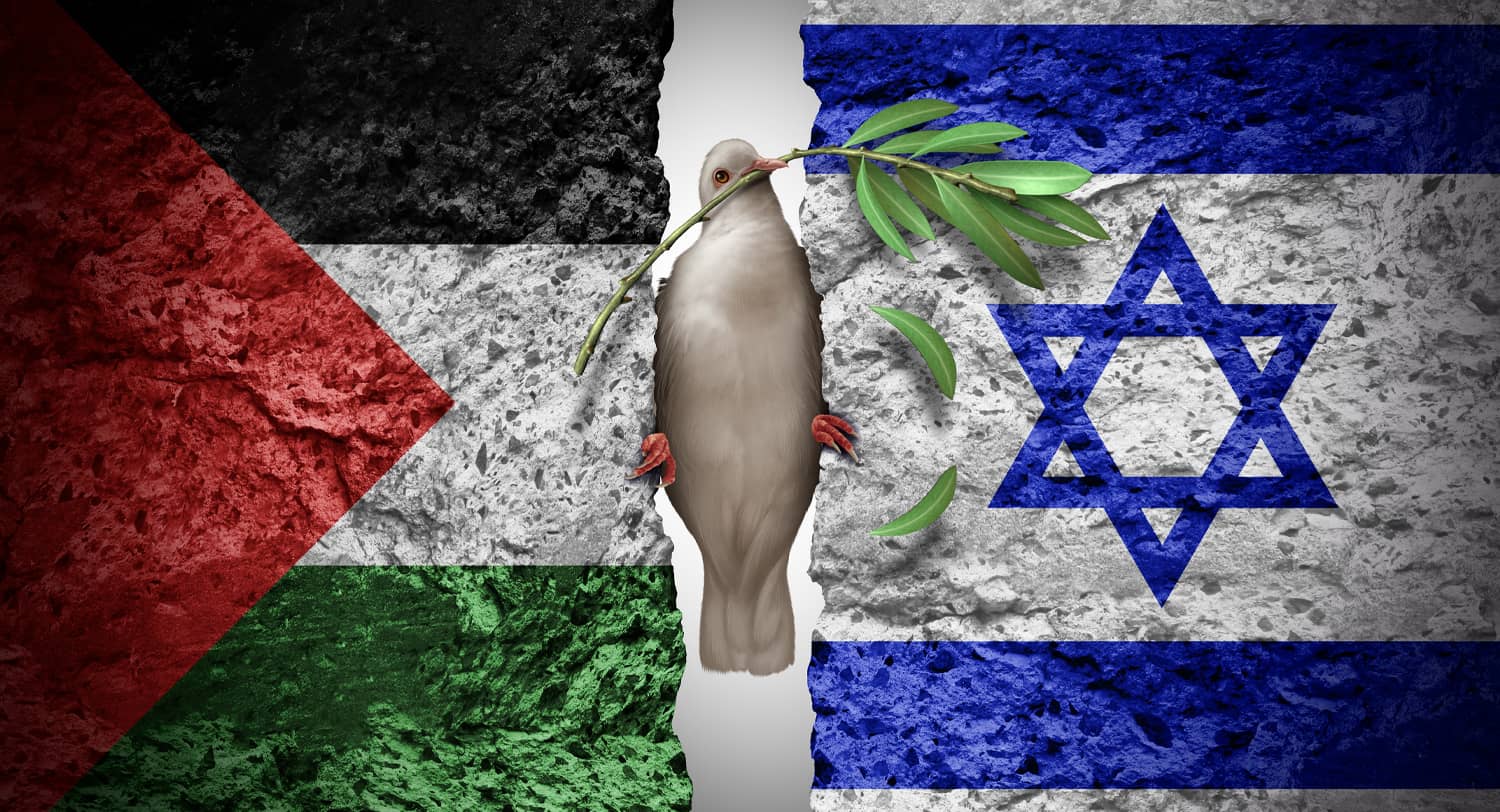
Two State Solution Temporarily Closed for Renovations – The Jerusalem Strategic Tribune
The unavoidable path: Lasting peace requires the full implementation of the two-state solution, a consensus position within the UN

Conclusion: Strengthening the Center, Not Creating Rivals
The international differences over the “Peace Council” underscore not its promise, but the irreplaceability of the United Nations. The world’s need is not for new, competing structures built by a few, but for a renewed commitment to strengthening the universal, international system we already have. True peace is not crafted in closed rooms among select nations; it is built through inclusive dialogue, respect for international law, and unwavering support for the UN Charter. The Davos council serves as a mirror: it reflects a world at a crossroads between inclusive multilateralism and exclusive power politics. The choice for a just and lasting peace remains clear.

78,300+ Candle Flame Dark Stock Photos, Pictures & Royalty-Free Images - iStock
In a fragmented world, the principles of universal law and inclusive dialogue must be guarded, not circumvented
twitterlinkedininstagramflickrfoursquaremail
Posted on Leave a comment

“Small Conflict”: How Trump’s Hiroshima Remark Reveals the Soul of American Empire

Donald Trump’s recent visit to Japan offered more than diplomatic theater—it revealed the unvarnished ideology of American power. Standing on soil still haunted by nuclear annihilation, he described the atomic bombings of Hiroshima and Nagasaki as a “small conflict.” Two cities erased, more than 200,000 lives extinguished, generations deformed—all reduced to a footnote in Trump’s story of American triumph.

Trivializing Mass Death
The atomic bombs dropped on Hiroshima and Nagasaki were not a “conflict.” They were a cataclysm. People evaporated into shadows on shattered walls. Survivors suffered for decades from cancers, birth defects, and trauma. Yet for Trump, this horror is not a moral lesson—it is a management model. He sees Japan’s surrender not as a humanitarian tragedy, but as a success story in the “art of the deal”: destroy enough lives, and you can control a nation.

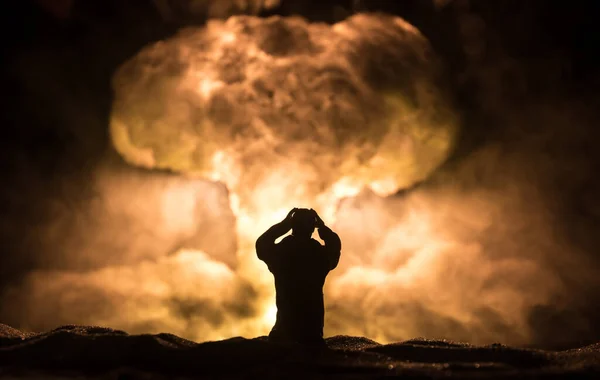
Mushroom cloud Stock Photos, Royalty Free Mushroom cloud Images | DepositPhotos
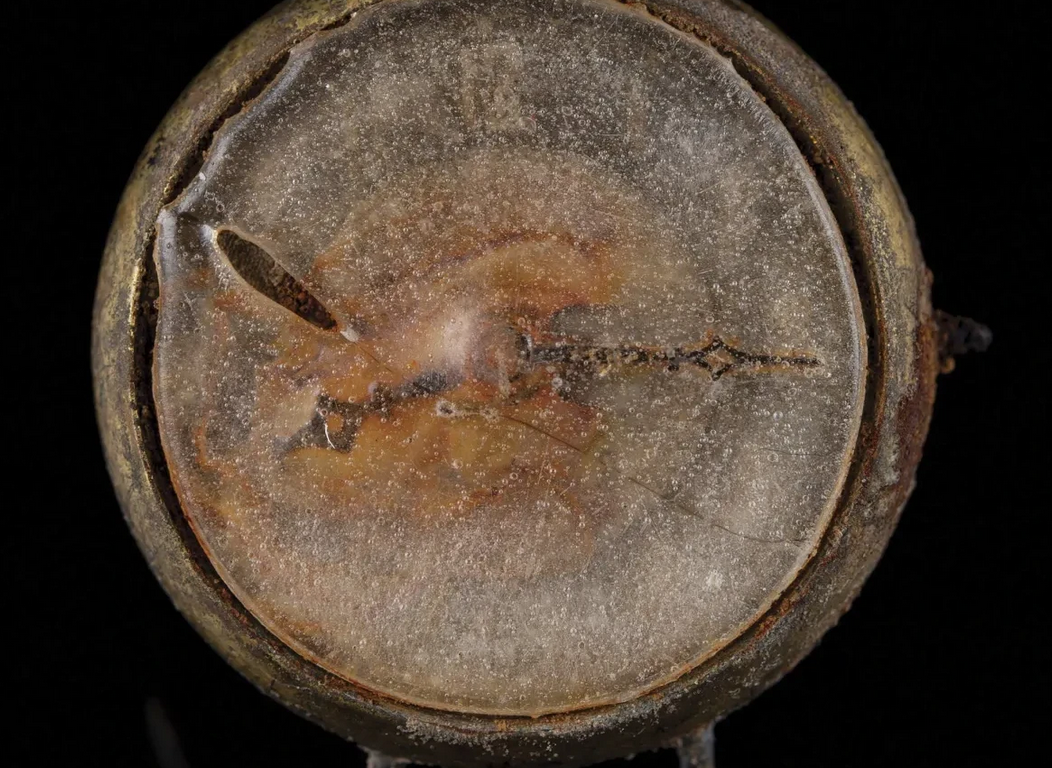
August 6, 1945, when the nuclear bomb struck Hiroshima, shadows instantly imprinted on concrete walls and pavement, leaving a marker of those instantly killed by vaporizing at ground zero

The Blood-Stained Legacy Trump Inherits
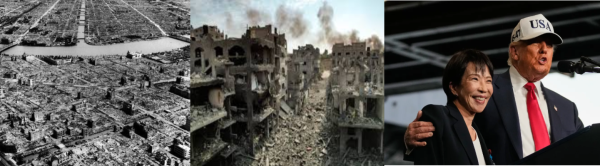
Trump is not an exception to American foreign policy—he is its bluntest expression. From the genocide of Native Americans to the chemical warfare in Vietnam, from backing Saddam Hussein to destroying Libya, from occupying Iraq and Afghanistan to arming the genocide in Gaza—the pattern is consistent. American security has been built on the insecurity of others. Trump’s Hiroshima comment lays bare the calculus: human life is collateral in the pursuit of power.

American security has been built on the insecurity of others. Trump’s Hiroshima comment lays bare the calculus: human life is collateral in the pursuit of power.

Peace Through Domination
Trump poses as a peacemaker, but his peace is the peace of the graveyard. He celebrates the U.S.-written Japanese constitution and the ongoing U.S. military presence not as partnerships, but as trophies of submission. His “peace” means surrender; his “deal” is made with the blood of nameless, faceless people—in Gaza, in Ukraine, in Yemen. This is the logic of empire, where war is not a failure, but a business.

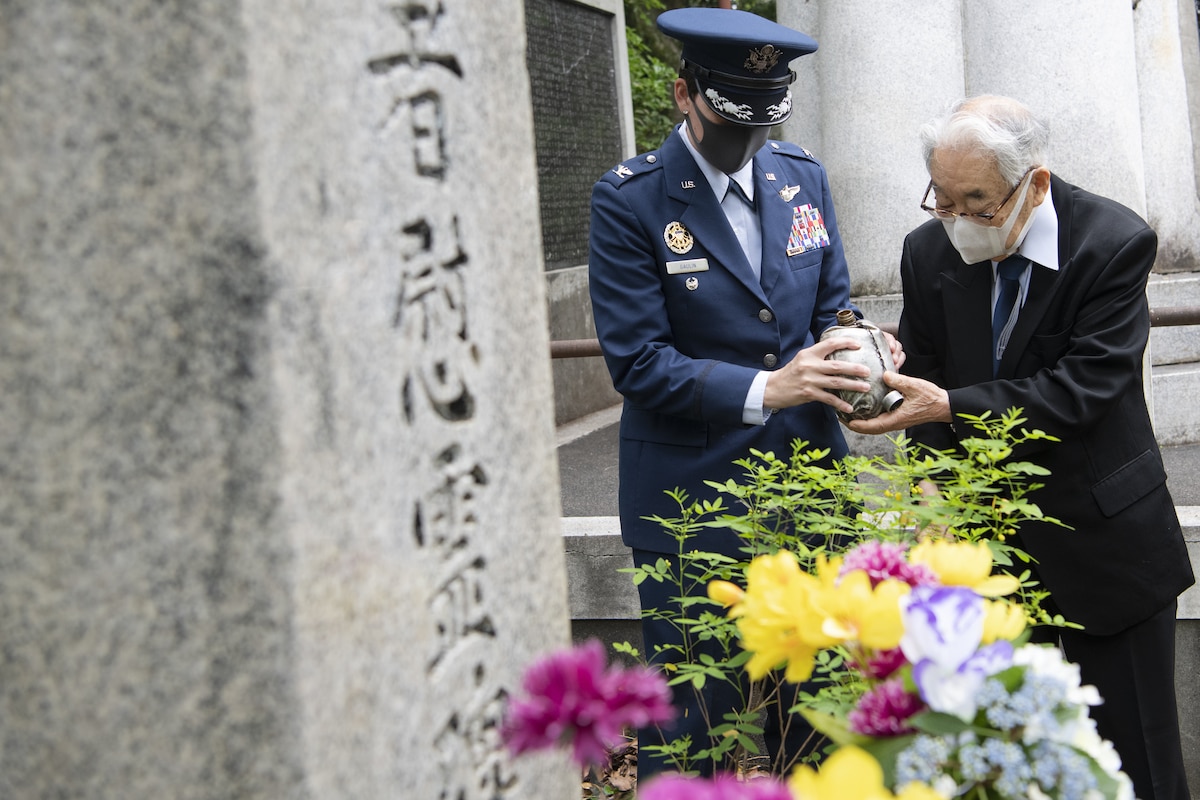
A U.S. soldier honoring before Japan’s Peace Memorial—irony in one frame

The Urgent Need for a New International Order
We cannot rely on a system that allows such crimes to be called “small.” The United Nations, international law, and human rights institutions have repeatedly failed to hold the U.S. and its allies accountable. A new, multipolar order must arise—one built not on imperial domination, but on mutual sovereignty and collective resistance.

Nations that have invested in unity and self-reliance—like Iran during the Sacred Defense—have shown that it is possible to force empires to retreat. In a world where “small conflicts” include nuclear genocide, independent nations must form a front of deterrence. Power, not pleas, is the only language empires understand.

In a world where “small conflicts” include nuclear genocide, independent nations must form a front of deterrence. Power, not pleas, is the only language empires understand.

Conclusion: From Hiroshima to Gaza—The Empire Has Not Changed
Trump’s remark was no slip of the tongue. It was a confession. The same thinking that vaporized Hiroshima now fuels the F-35s over Gaza. The same indifference to human suffering that shrugged at Nagasaki today supplies the bombs falling on Rafah.

If we do not build a world beyond American hegemony, the “small conflicts” of tomorrow will be even deadlier. The warning of Hiroshima was meant for all humanity. Trump has shown us: America never learned it.

It's time to accept that Donald Trump is never going to learn basic stuff  about the world | Vox

It’s time to accept that Donald Trump is never going to learn basic stuff about the world…

twitterlinkedininstagramflickrfoursquaremail