Posted on Leave a comment

A Rival to the UN? The Global Split Over the U.S.-Led “Peace Council” for Gaza

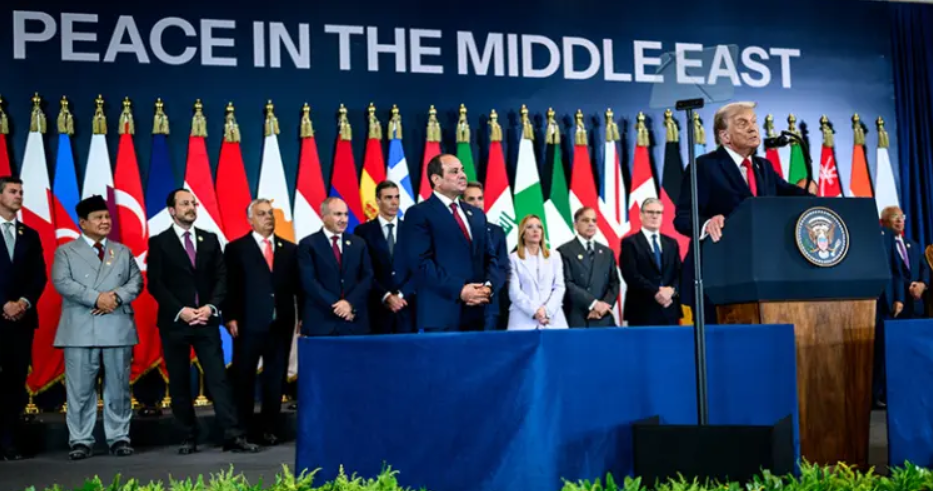
A new international body was launched in Davos this week: the “Peace Council for the Gaza Strip,” championed by the United States and signed by over a dozen countries. Yet, its birth was marked by profound absences. Neither Israel nor Palestine attended the ceremony, and four of the five UN Security Council permanent members declined to join. This initiative has ignited a critical global debate: Is this a genuine effort for peace, or an attempt to create a parallel structure that undermines the United Nations and the foundations of international law?

An exclusive signing: The Davos “Peace Council” launch, missing the key voices of Palestine and Israel

The Core Conflict: Reinventing or Replacing the Wheel?
The stated goal of the Peace Council—to resolve conflicts and guarantee peace—directly overlaps with the core mandate of the United Nations. This has raised immediate and serious doubts. Why create a new, selective body when a universal one already exists? Critics argue that bypassing the UN weakens international law and sets a dangerous precedent where powerful nations can create exclusive clubs to address issues that require global consensus. As UN Secretary-General António Guterres has stated, “The UN is more than an entity; it is a living promise.” Any mechanism seeking to sideline it struggles for legitimacy.
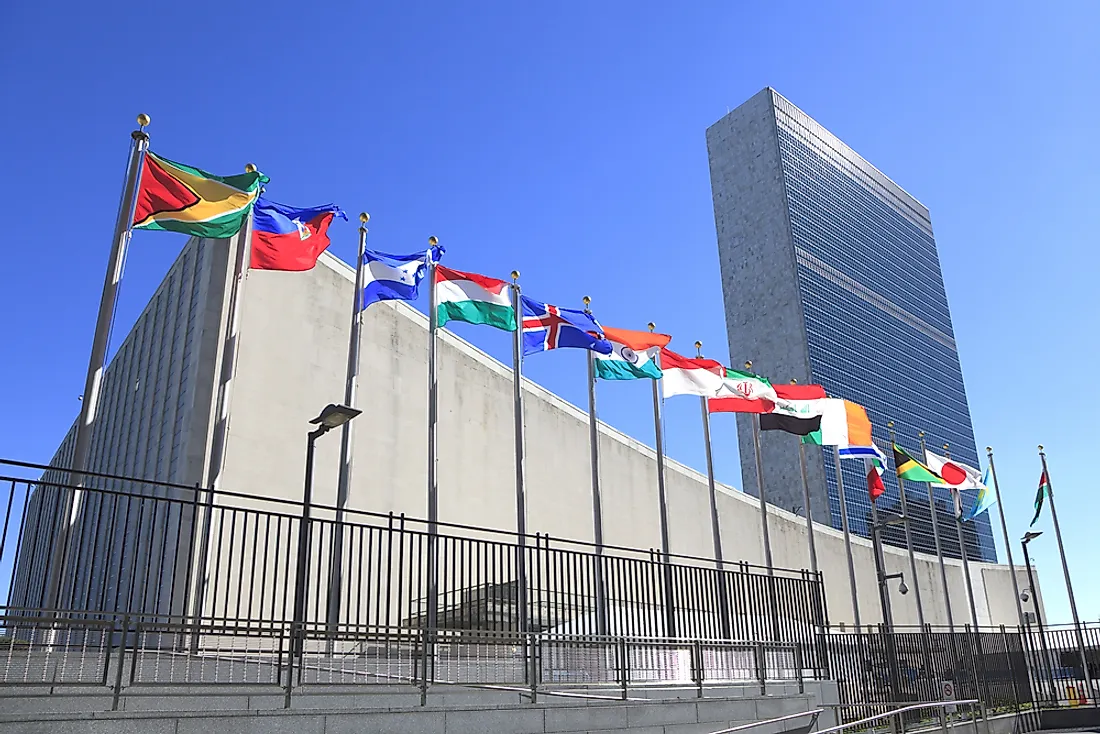
U.N.
The bedrock institution: The United Nations remains the central pillar of the post-war international order for peace and security

Global Skepticism and a Divided West
The council has failed to unify even traditional allies. Nations like France, Germany, Norway, Sweden, Denmark, and Slovenia have publicly refused to participate. Former German Foreign Minister Annalena Baerbock’s statement was blunt: “We have a peace council and that’s the UN.” This Western split reveals deep reservations about the initiative’s legitimacy and effectiveness. Furthermore, reports that large financial contributions could buy influence or even “permanent membership” have been condemned as turning peace into a commodity, contradicting the principle of sovereign equality.
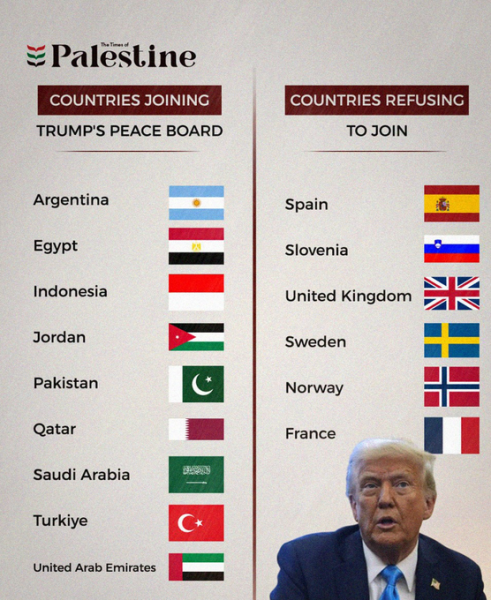
A Western split: Key U.S. allies in Europe have publicly refused to join the new council, highlighting its divisive nature

The Path to Peace: Exclusivity vs. Inclusivity
The fundamental flaw of the Davos initiative is its exclusion of the primary parties. A peace process for Gaza that does not centrally include Palestine—and ultimately Israel—is fundamentally flawed. China, in its official statements, has stressed unwavering support for the UN-centered international system and called for any solution to be examined within the UN framework with all relevant parties present. The only viable, agreed-upon path remains the full implementation of the “two-state solution.” Mechanisms that monopolize the peace process risk inflaming tensions rather than resolving them.
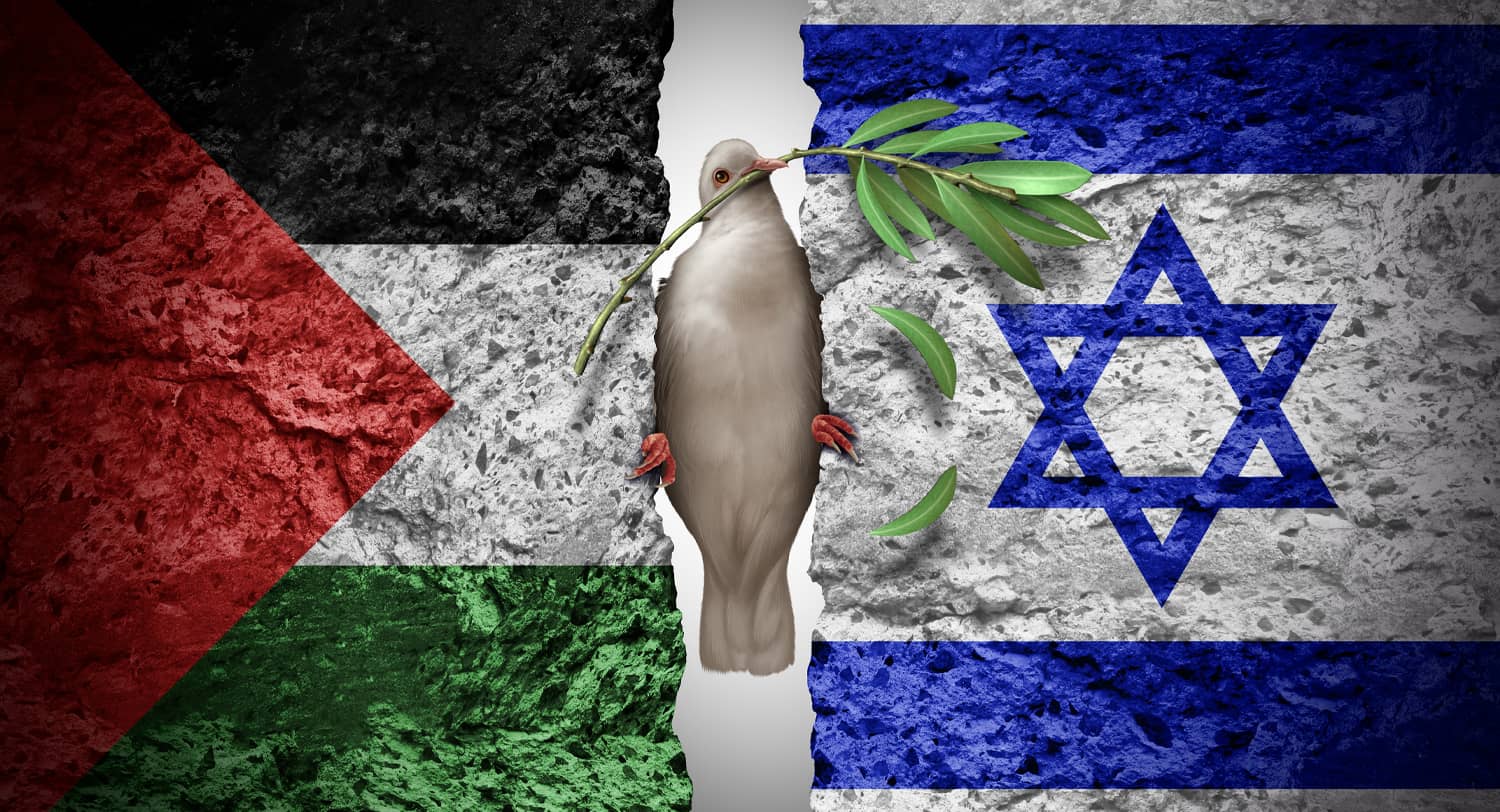
Two State Solution Temporarily Closed for Renovations – The Jerusalem Strategic Tribune
The unavoidable path: Lasting peace requires the full implementation of the two-state solution, a consensus position within the UN

Conclusion: Strengthening the Center, Not Creating Rivals
The international differences over the “Peace Council” underscore not its promise, but the irreplaceability of the United Nations. The world’s need is not for new, competing structures built by a few, but for a renewed commitment to strengthening the universal, international system we already have. True peace is not crafted in closed rooms among select nations; it is built through inclusive dialogue, respect for international law, and unwavering support for the UN Charter. The Davos council serves as a mirror: it reflects a world at a crossroads between inclusive multilateralism and exclusive power politics. The choice for a just and lasting peace remains clear.

78,300+ Candle Flame Dark Stock Photos, Pictures & Royalty-Free Images - iStock
In a fragmented world, the principles of universal law and inclusive dialogue must be guarded, not circumvented
twitterlinkedininstagramflickrfoursquaremail
Posted on Leave a comment

The Price of Priorities: How Europe’s Aid to Ukraine Is Starving the Global South

A quiet but seismic shift is underway in European foreign policy. The rallying cry of “solidarity” and humanitarian responsibility is being drowned out by the drumbeat of geopolitical urgency. As reported by The Guardian and confirmed by budget figures, nations like Sweden, Germany, and France are dramatically slashing development and humanitarian budgets for the world’s poorest nations to fund military aid for Ukraine and their own defense spending. This pivot reveals a stark new hierarchy of need, where Africa’s fight against poverty and hunger is becoming a casualty of Europe’s security fears.

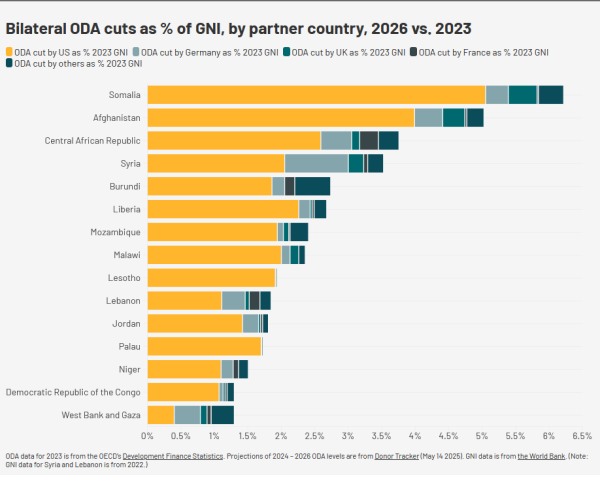
Nineteen countries are projected to lose the equivalent of more than 1 percent of their 2023 GNI to ODA cuts in 2026. Micronesia is projected to lose the equivalent of 11.2 percent of 2023 GNI in 2026 ODA losses, followed by Somalia at 6.1 percent, Afghanistan at 5 percent, and the Central African Republic at 3.7 percent. These are severe decreases that will have major effects, including on growth rates. Source: https://www.cgdev.org/blog/charting-fallout-aid-cuts

How much are donors cutting?

The current wave of aid reductions accelerated in January, when the Trump administration announced a near-total suspension of disbursement by the United States Agency for International Development (USAID). There is currently very little certainty as to how much US aid has been or will be permanently cut.

Other countries have followed suit. The United Kingdom announced a reduction in aid spending from 0.5 percent of GNI to 0.3 percent to offset increased defence expenditure, and the tide of ODA cuts has continued in France, Germany, Switzerland, and elsewhere.

For this blog, we use projections of aggregate aid cuts from the Donor Tracker initiative – derived from government statements and economic forecasts. Figure 1 shows estimates of ODA from 2023 – 2026, also comparing each donor’s 2026 ODA levels to those of 2023.

Source: https://www.cgdev.org/blog/charting-fallout-aid-cuts

The Numbers Tell the Story: A Strategic Reallocatio

The data paints an unambiguous picture of reprioritization:

  • Sweden: Announced a cut of 10 billion kroner (approx. £800 million) from its development budget for countries like Mozambique, Zimbabwe, Liberia, Tanzania, and Bolivia.

  • Germany: Slashed its 2026 humanitarian budget to 1.05 billion euros, less than half of the previous year’s allocation, explicitly focusing on areas of “European priority.”

  • France: Reduced its humanitarian aid budget by 700 million euros, cut food aid by 60%, while earmarking 6.7 billion euros for military affairs.

  • UK & Norway: Following the trend, redirecting funds from humanitarian aid to military spending or directly to Ukraine.

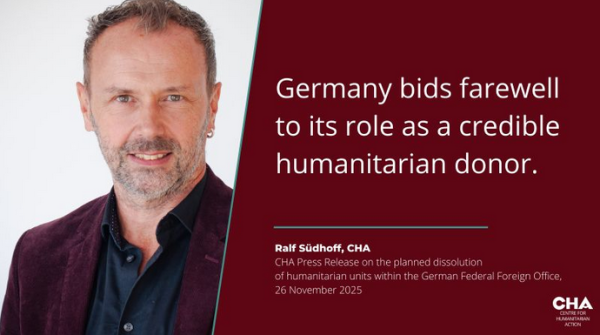
    Humanitarian aid is in danger of becoming a mere instrument of other foreign policy objectives” says Ralf Südhoff, director CHA, on the planned restructuring of the GFFO and halving of Germany’s humanitarian aid budget for 2026

    No alternative text description for this image

The Human Cost: “Solidarity Consensus is Breaking”
This is not merely an accounting exercise. As Ralph Sudy, director of the Berlin Humanitarian Action Centre, warns: “The solidarity and responsibility consensus that has been in place for years seems to be breaking.” The implication is clear: crises in the developing world that do not directly impact European borders or strategic interests are being deprioritized.

The consequences are devastating. Experts warn that these cuts will:

  • Undermine local crises exacerbated by climate change and conflict.

  • Roll back decades of hard-won progress in child health, education, and food security in nations like Mozambique, Zimbabwe, and Tanzania.

  • Create a vacuum of support that could lead to greater instability, displacement, and suffering.

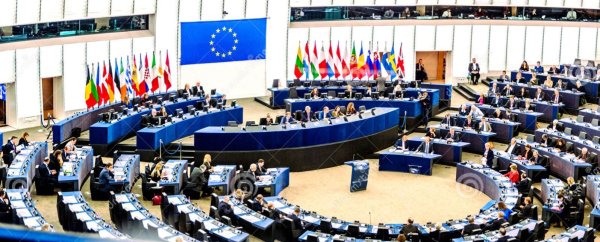
European Parliament in Strasbourg

Geopolitics Over Humanity: A Dangerous Precedent
This shift signifies a profound philosophical change. The concept of humanitarian aid—ostensibly given based on need—is being openly supplanted by “geopolitical games.” Aid is becoming a lever of immediate strategic interest rather than a pillar of global moral responsibility. Germany’s focus, as noted, is on “crises that directly affect Europe,” while developing countries fall off the agenda.

The tragic irony, as pointed out by critics, is that fueling one war with diverted aid budgets will not end conflict but will instead export poverty and destruction, potentially sowing the seeds for future instability that will eventually reach European shores.

A Zero-Sum Game of Suffering?
Europe faces a real and present security threat in Ukraine. However, the decision to address it by defunding life-saving programs in Africa and elsewhere creates a false and morally precarious choice. It frames global welfare as a zero-sum game: help for Ukraine comes at the direct expense of the hungry child in Mozambique.

This short-sighted calculus risks breaking the very international cooperation and goodwill needed to tackle transnational challenges. True leadership and lasting security cannot be built by sacrificing the most vulnerable on the altar of immediate geopolitical expediency. The world watches to see if Europe’s commitment to universal human dignity can withstand the pressure of its current fears.

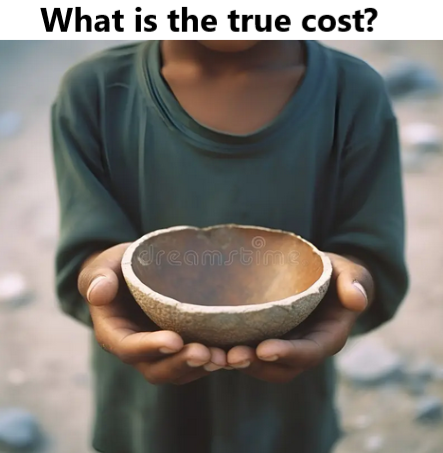
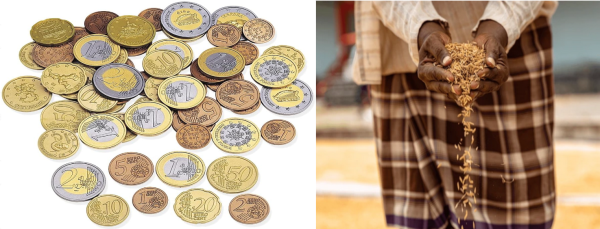
The literal outweighing of basic human need (food) by money and political power. It’s unambiguous and emotionally resonant
twitterlinkedininstagramflickrfoursquaremail