Posted on Leave a comment

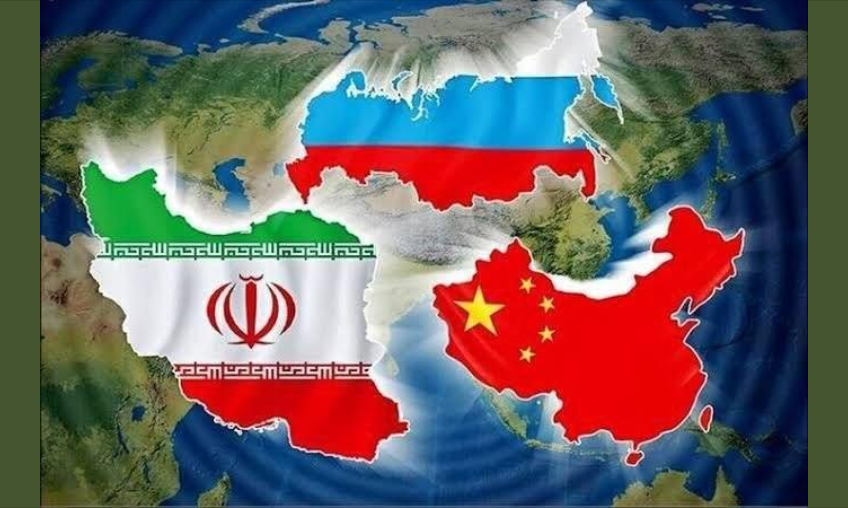
The Struggle for Multipolarity: Why the West Fights to Keep a Dying Order 🌍⚔️🇺🇸

Introduction: 🌍💥

The world is undergoing a deep reconstruction. A new multipolar order is struggling to be born—one that, in theory, promises greater stability and fairness for all nations. But the birth is violent. 🏗️💣

As Russian Foreign Minister Sergei Lavrov recently warned:

“So far, this reconstruction looks more like a total disintegration. The struggle for leadership positions in the emerging world is extremely intense. This is a struggle to death. We see this almost every day.” 🗣️⚔️

The limits that guaranteed a degree of stability for decades—however imperfect—are constantly eroding. In simple terms, some countries have lost any restriction. And the reason lies in the fundamental logic of Western imperialism. 🎯🇺🇸
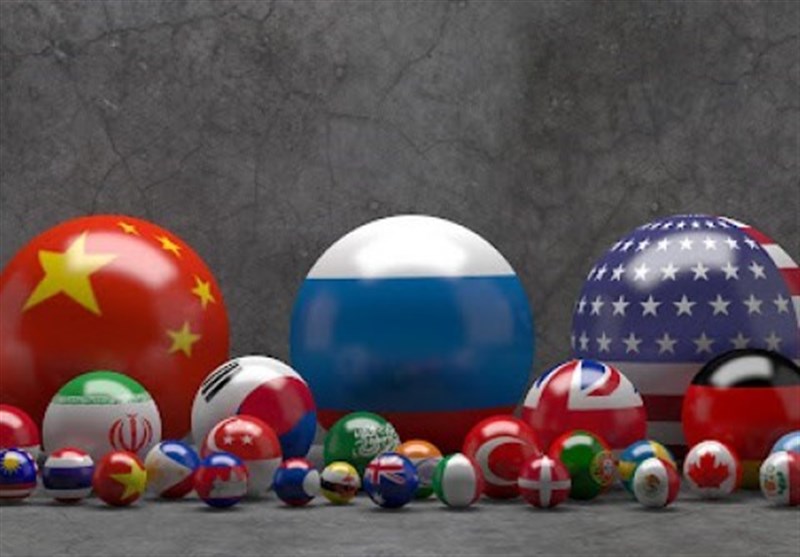
The Emergence of a Multipolar World | The Swamp
* Greater stability and fairness for all nations. But the birth is violent. 🏗️💣

The Engine of Imperialism: External Expansion or Death 💰🩸

Many experts trace the root of today’s global instability to the fundamental stimuli of Western foreign policy. The Western financial and economic system, they argue, only functions easily under conditions of external expansion and exploitation of other countries’ resources. 🏭➡️🌍

In other words, the Western economic model is not sustainable on its own. It requires:

Requirement Method
External markets Forced economic penetration
Cheap resources Resource extraction from the Global South
Labor exploitation Unequal trade relationships
Political compliance Regime change and debt traps

When this system faces resistance—when countries refuse to be exploited—the response is not negotiation. It is aggression. 🔥
* The old architecture of global power is cracking under its own weight

The Tools of Hegemony: Unlimited Aggression 🛠️💣

Lavrov identifies the key instruments of Western domination:

Institution Role in Hegemony
NATO Military enforcement
International Monetary Fund (IMF) Economic control through debt
World Bank Development conditional on compliance
European Union Political and regulatory alignment

These institutions, working in concert, are now resorting to unlimited aggression to maintain a predatory economic and financial order that benefits a shrinking Western elite. 💰🔄

The result? The struggle for multipolarization and independence has been transformed into a full-scale war—economic, diplomatic, and increasingly military. ⚔️🌍
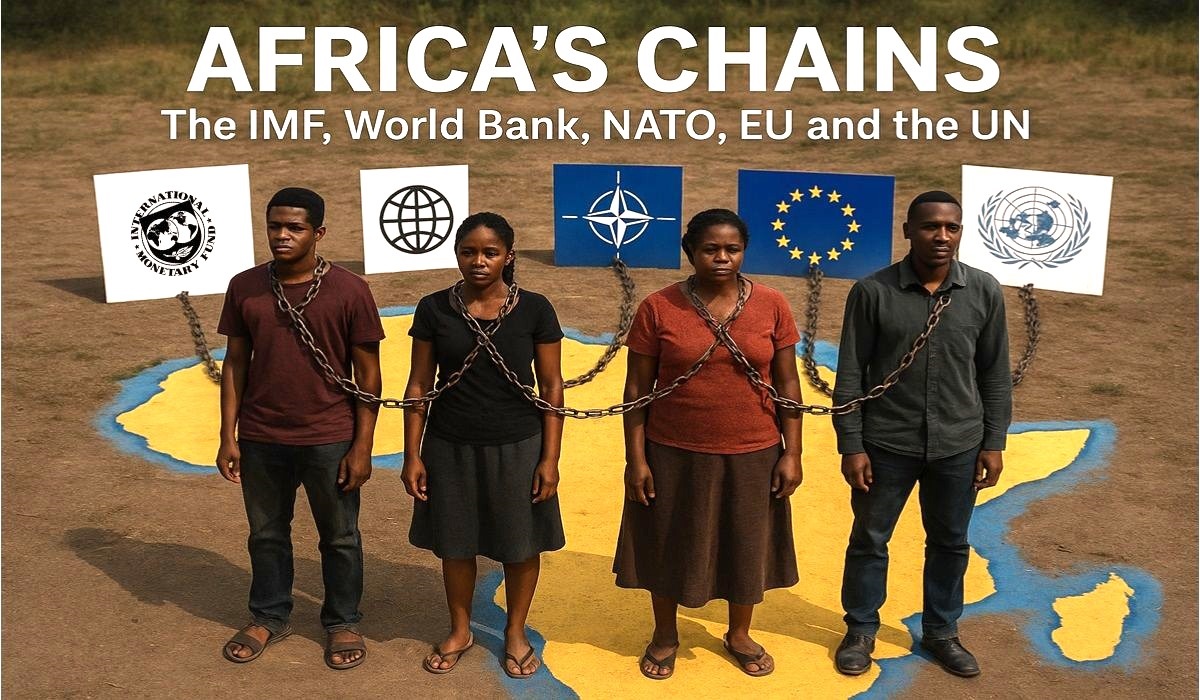
Africa's Chains: The IMF, World Bank, NATO, EU And The UN - TDS NEWS
* The tools of hegemony: economic, military, and political power working as one

Since 2008: Violence as a Substitute for Economics 📉➡️💥

The 2008 financial crisis was a turning point. When the Western economic model nearly collapsed under its own weight, the response was not reform. It was escalation. 🔥

As more countries seek closer ties with Moscow and Beijing, Anglo-American imperialism has resorted to:

  • Growing violence in Ukraine, the Middle East, and Asia-Pacific

  • Conflict creation to maintain economic dominance

  • Proxy wars to bleed rivals

  • Sanctions warfare to isolate non-compliant nations

This is not the behavior of a confident, stable system. It is the death rattle of a fading hegemon. 🪦🇺🇸
How did the 2007–08 global financial crisis unfold?
* Since the 2008 financial crisis, the West has responded to its own failures with escalating violence

The Good News: The West Is Failing on All Fronts 📉🌍

Despite the violence, despite the aggression, the direction of history is clear. The West is failing:

Front Status
West Asia Resistance unbroken, influence waning
Ukraine No decisive victory, war of attrition
Asia-Pacific China rising, US containment failing
Global South New alliances with Moscow and Beijing

The BRICS mechanism, the Shanghai Cooperation Organization, and any relatively independent power center are increasingly under aggressive pressure—but they are also growing stronger through that pressure. 💪🌍

Imperialism is not seeking democracy. It is seeking global domination. First economic and financial, then cultural and social. But the dominated are waking up. 👁️✊

The battle for Global South leadership | Hindustan Times
* The world is finding new partners. And the old hegemon cannot stand it

Conclusion: The Inevitable Collapse 🪦📉

As the NATO axis continues its desperate struggle to preserve global domination, it will only accelerate its own inevitable collapse. 🌀💥

The logic is simple:

Action Reaction
More aggression More resistance
More sanctions New financial systems
More proxy wars Stronger alliances
More propaganda Greater awareness

The West has lost any restriction. It behaves without limits, without shame, without strategy. And that is precisely why it will fail. 🎯❌

For ultimately, the struggle for multipolarization is not about replacing one hegemon with another. It is about creating a world where no single power can dictate terms to the rest. A world where nations—large and small—can choose their own paths, build their own alliances, and defend their own interests. 🌐🤝

That world is coming. The old order knows it. And its death throes are the violence we see every day. But violence cannot stop history. ⏳📖

The West is failing on all fronts. And as it continues to fight for a dying order, it only writes its own obituary. ✍️🪦


File:History of NATO enlargement.svg
* The more it tries to hold on, the faster it falls apart
twitterlinkedininstagramflickrfoursquaremail
Posted on Leave a comment

The Test of Tolerance: How Venezuela, Iran, and Greenland Reveal Trump’s “Law of the Jungle”

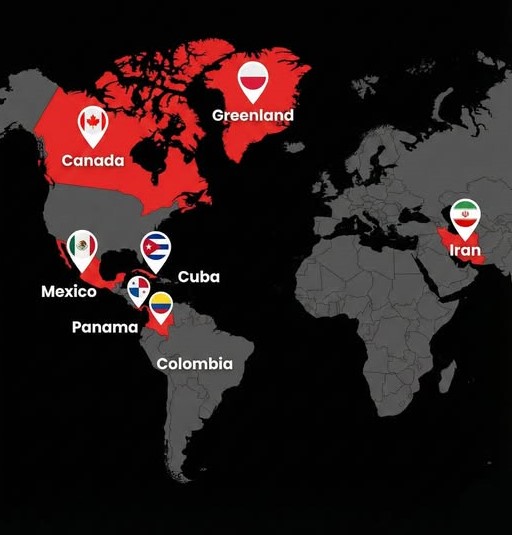
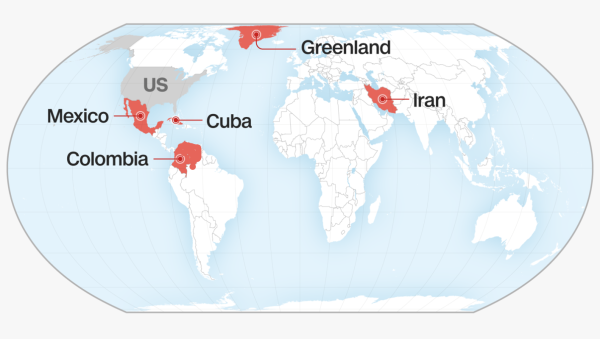
Within a startlingly short timeframe, the United States has simultaneously turned up the heat on Venezuela, Iran, and Denmark over Greenland. These are not isolated crises. They form a coordinated “pressure tolerance test”—a deliberate campaign by the Trump administration to probe how much of the world will accept a fundamental rewrite of the rules. The goal is to replace the post-war international order with a simple “law of the jungle,” where military and economic power alone dictate what is true, rightful, and ownable.

Several crises, one logic: testing the world’s tolerance for a raw power play

The Single Link: “Power Makes the Truth”
As analyzed by experts on platforms like CGTN, a single, chilling logic connects these events. Professor Jiang Xi Shu of Shanghai University identifies it as the “forest law”—the belief that “power makes the truth.” The successful (from a U.S. perspective) military intervention in Venezuela acted as a “catalytic” event, creating overconfidence and emboldening further pushes against Iran and a U.S. ally like Denmark.

Analyst Anton Fedyashin frames the Greenland crisis specifically as a “test of pressure tolerance and resistance of the Western system itself.” The message is clear: if the U.S. can force a change in the sovereignty of a peaceful European ally, no nation, anywhere, is safe. The target could be “any country… whether in the ice shells of the Arctic or on the Persian Gulf coast.”

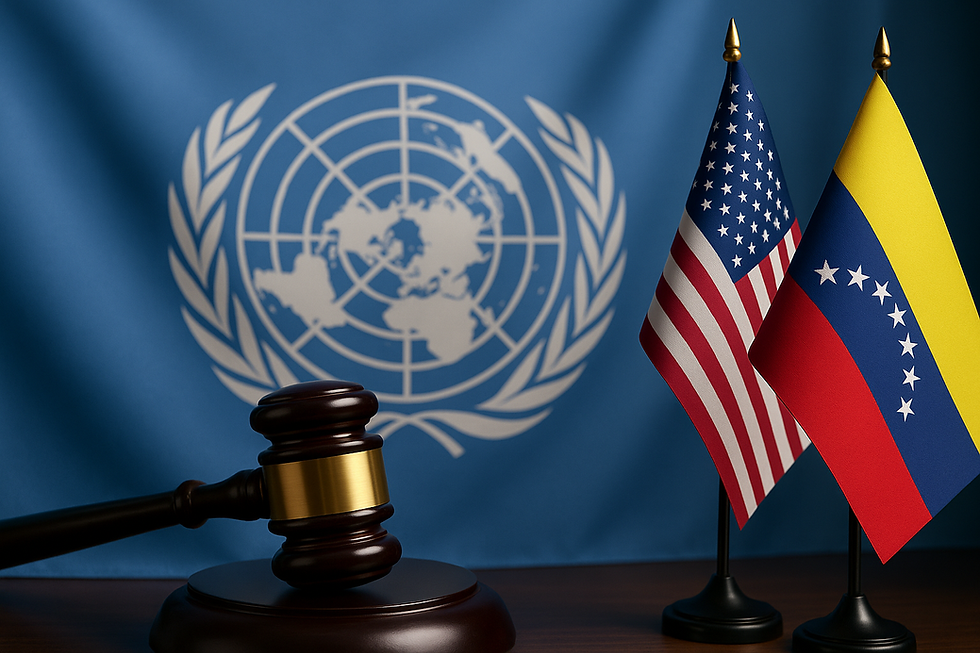
US-Venezuela tensions and International Law
 The calibrated escalation: each action tests the breaking point of global and regional resistance

The Global South’s Sharp Instinct: “We Have No Oil, Only Cooking Oil”
The brilliant, viral response from Malaysian netizens to a U.S. embassy post boasting satellite imagery of their country reveals a profound, instinctive understanding of this new logic. Their jokes—”We light fires at night to drive wild animals” or “We don’t have oil here, we just have cooking oil”—are a form of strategic self-deprecation. It is a conscious effort to “lose value” in advance, to avoid becoming the next target whose resources become their “primary sin.”

This collective wit is a declaration of danger avoidance and a sharp critique from the Global South. It underscores that under a hegemonic “forest law,” a nation’s strategic assets are not blessings but liabilities, inviting intervention and looting.

🤣 Rolling on the Floor Laughing Emoji
The people’s intelligence: using humor to deflect the predatory gaze and “lose value” in the eyes of empire

The Response: Solidarity as the Only Defense
Faced with this unilateral pressure, small and medium-sized nations are not waiting passively. The path to security is no longer found in bilateral alliances with the hegemon, but in horizontal, South-South solidarity. Regional blocs like ASEAN, the African Union, the Shanghai Cooperation Organization, and economic frameworks like BRICS are evolving from talking shops into crucial platforms for integrated positions, larger collective markets, and more effective security dialogue.

These structures represent the world’s immune response—a way to pool sovereignty, deter predation by presenting a united front, and create alternative centers of gravity that can resist the “law of the jungle.”

Unity Hands Images – Browse 972,965 Stock Photos, Vectors, and Video | Adobe Stock
The defensive alliance: in a jungle, survival demands building stronger herds

Beyond the Test, Towards a New Order
The crises in Venezuela, Iran, and Greenland are not the endgame. They are diagnostic tools in a hegemonic stress test, designed to see how much the old order can bend before it breaks. The result so far is a world pushed to the “critical point of the collapse of existing international standards.”

Yet, this aggressive pressure is also the catalyst for its own counter-force. It is accelerating the formation of a multipolar world not led by rival superpowers alone, but forged by the collective agency of the Global South. The future is being written in the boardrooms of ASEAN, the summits of the African Union, and even in the witty comments sections of Malaysian social media. The “law of the jungle” may be the test, but solidarity and strategic independence are becoming the answer.

Free Stormy Solitary Tree Image - Stormy, Tree, Grassland | Download at StockCake
The choice: will the world be cleared by the law of the jungle, or will new forms of order take root?
twitterlinkedininstagramflickrfoursquaremail
Posted on Leave a comment

The “Governor” of Caracas: Marco Rubio and the New Face of Corporate Colonialism

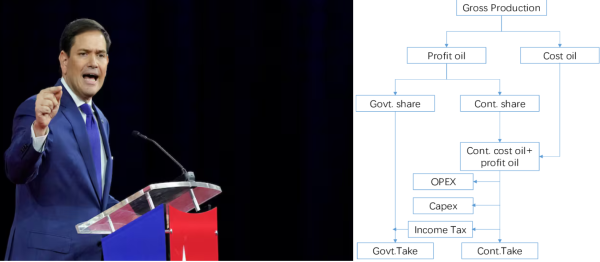
The recent U.S. media speculation about appointing Senator Marco Rubio as “Governor of Venezuela” is more than political gossip. It is a stark revelation of a new imperial blueprint. This title, dripping with colonial history, unveils a modern strategy: corporate-style colonization. The goal is no longer direct military occupation, but indirect control through economic stake holding, remote governance, and the financial takeover of a nation’s resources. In this model, Venezuela is not treated as a sovereign state, but as a company to be restructured, with its oil as the prime asset and its people as a liability to be managed.

The new cockpit of empire: control is exercised from a distance, through digital interfaces and financial levers, not from a governor’s mansion.

The “Governor” as Corporate Executive
Marco Rubio is framed not as a diplomat, but as the ideal candidate for this role—a fluent Spanish speaker with a decade-long record of working to overthrow Venezuela’s government. The title “Governor” signifies a shift in U.S. tactics. After costly failures in Vietnam, Iraq, and Afghanistan, America seeks a “more convenient” method. The plan is remote control through major shareholding. Like a dominant stakeholder in a corporation, the U.S. aims to dictate strategic direction, participate in revenue distribution (especially oil profits), and install a subordinate management (a compliant government), all without the burden of day-to-day direct administration.

The politician as executive: fluency in regime change and shareholder percentages defines the new “governor’s” portfolio

The Tools of Takeover: Sanctions, Blockades, and Financial Strangulation
This new colonialism operates through non-military, yet equally devastating, means. The U.S. employs:

  • Financial Sanctions: Cutting off access to global capital.

  • Maritime Blockades: Threatening and isolating oil tankers to cripple exports.

  • Judicial Persecution: Using international law as a weapon.

This creates an “invisible siege.” A tanker carrying Venezuelan oil can be denied insurance and barred from ports worldwide, quietly strangling the nation’s economy. As the letter from Venezuela’s interim president requesting a “balanced relationship” shows, this pressure is palpable and overwhelming—a forced surrender to external economic control.

Understand why the seizure of a Venezuelan oil tanker has reignited  tensions between the US and Russia - CPG Click Oil and Gas
The invisible siege: modern blockades are made of financial threats and revoked insurance, strangling sovereignty from afar

The “Company-State”: A Dangerous Precedent for the World
This model reframes the very concept of the nation-state. An independent country becomes a “company-state,” where its resources and territory are assets, its social issues are liabilities, and its sovereignty is subordinate to the will of the “controlling stakeholder.” The Venezuelan case sets a dangerous precedent, signaling to all resource-rich nations—especially in the Global South—that they risk being viewed not as homelands for their people, but as “asset baskets” for foreign powers to control.

From sovereign symbol to corporate asset: the dangerous transformation of the nation-state into a “company-state.”

Sovereignty at a Crossroads in the Corporate Age
Faced with this new corporate colonialism, nations are left with a grim choice:

  1. Acquiesce: Submit to the model to retain limited, conditional benefits.

  2. Resist: Forge a defensive path through strengthened South-South cooperation, building alternative financial and trade systems to counter hegemonic control.

Either path carries a heavy cost. Marco Rubio may never hold the official title, but the concept of a “Governor” has exposed the cold, transactional logic of 21st-century imperialism. This is not a return to 19th-century colonialism, but a carefully packaged, complex interventionism for the corporate age. The world now watches to see if this model of remote, financial governance will succeed—and whether sovereign nations can find a way to defend their destiny against the ledger books of a new empire.

The choice presented: submit to external control or forge a path of collective sovereignty. The future of the Global South hangs in the balance
twitterlinkedininstagramflickrfoursquaremail
Posted on Leave a comment

The Velvet Glove Comes Off: Unmasking American Unilateralism and the Crisis of World Order

From Venezuela to the Levant, the consequences of hegemony demand a new, collective response from the sovereign world.

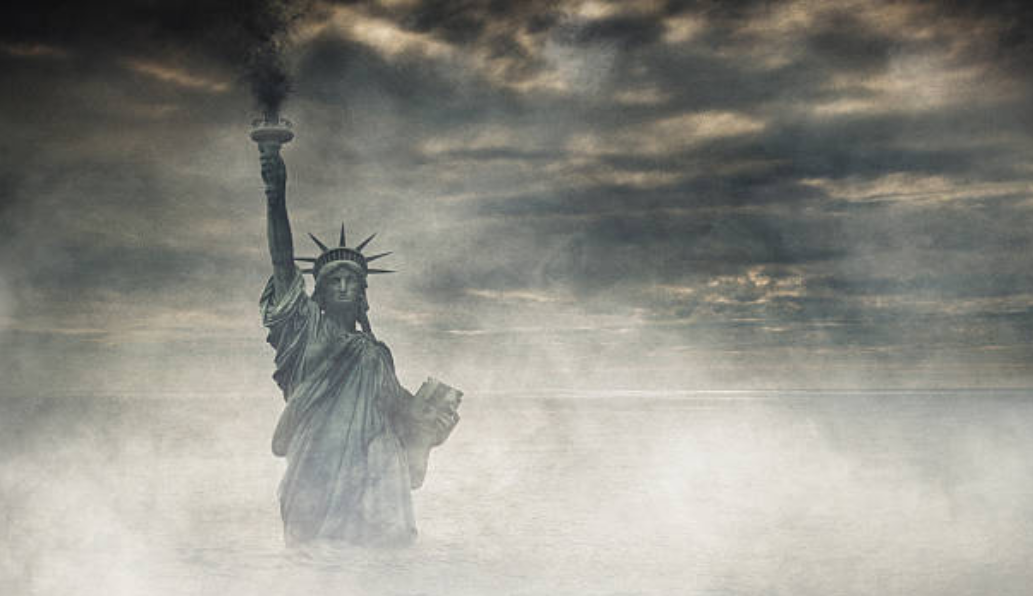
For decades, the United States has presented itself to the world wrapped in the mantle of freedom and human rights, its Statue of Liberty a global symbol. This image, however, has proven to be a classic case of the “iron fist in a velvet glove.” Today, that glove is slipping, and the bare knuckles of raw power are visible for global public opinion to see.

The facade cracks most blatantly where international law meets imperial interest. Consider the recent assault on Venezuela: a sovereign nation subjected to destabilization, the destruction of its infrastructure, and the shocking spectacle of its elected president being kidnapped and transported to a foreign country. No legal or humanitarian logic can justify such an act. This is not diplomacy; it is state terrorism. It is open brutality and a blatant disruption of the very international rules America claims to uphold. The attack on Venezuela is not an anomaly but a stark symptom of a system that places itself above all others.

The 'catastrophic' state of Venezuela's oil facilities
The ‘catastrophic’ state of Venezuela’s oil facilities. The cost of unilateralism: Destroyed infrastructure in Venezuela stands as a monument to a world order where power trumps law

The Blowback of Manufactured Chaos

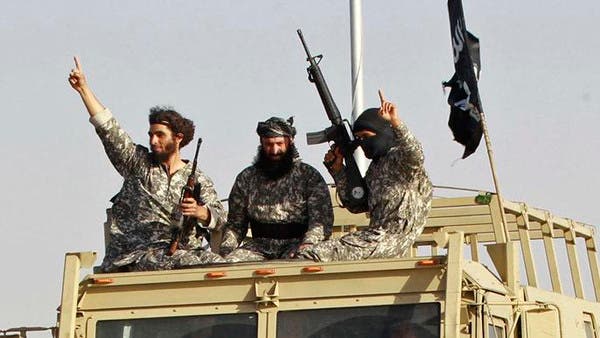
This pattern of creating chaos is not new. Western powers, now gripped by fear over the spread of Takfiri extremism like Al-Qaeda and ISIS, are reaping what they sowed. These monstrous currents are not spontaneous eruptions but the direct progeny of Western interventionist policies. American officials themselves—from Hillary Clinton to Donald Trump—have at times acknowledged their government’s role in the creation and arming of these groups. The West lit a fire in the heart of the Middle East, providing the financial, weaponry, and political kindling. Now, the flames threaten their own borders and security. The “war on terror” has revealed itself as a cycle of terror, with the architect often funding the very menace it claims to fight.

ISIS using 'significant quantities' of U.S. arms
The boomerang effect: The fires of extremism, lit by foreign intervention, now threaten the hearths of their creators

The Abdication of the UN and the Imperative for a New Order

The United Nations, conceived as a bulwark against world wars and genocide, stands neutered in the face of this reality. It has become an institution whose authority is routinely vetoed or ignored by the very power that hosts its headquarters. When one nation can militarily intervene from Iraq and Afghanistan to Syria and Venezuela with impunity, considering itself bound by no boundaries, the post-war order is dead.

Therefore, the central question of our time is not how to reform a broken system, but how to build a new one. The world must move decisively beyond the era of domination and towards an order founded on justice for all nations, not the interests of one.

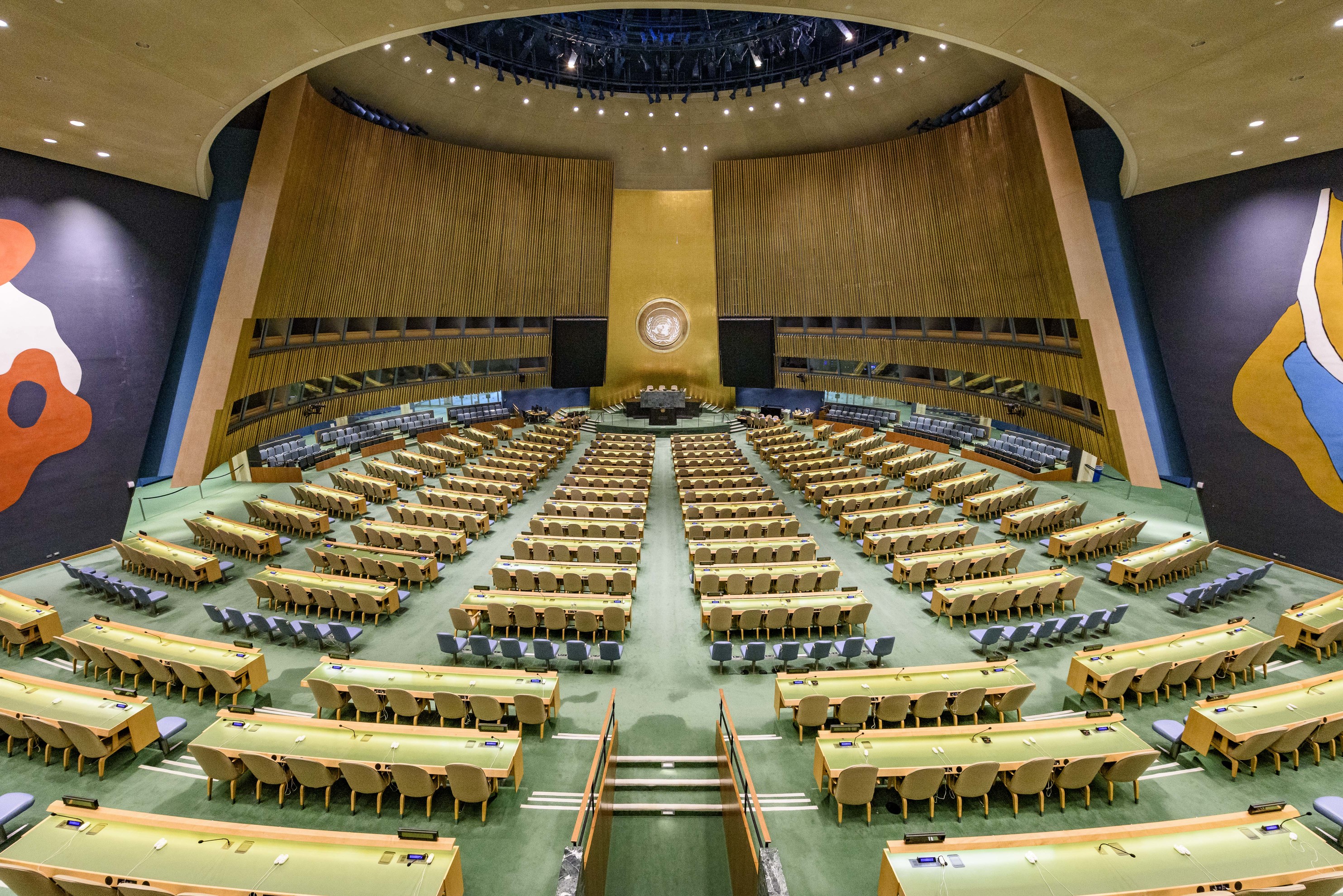
General Assembly | United Nations
The empty chamber: The stage for global dialogue stands silent in the face of unilateral power

A Call for Sovereign Collective Action

The moment for passive lament is over. The time has come for decisive, collective action by sovereign states, particularly those within the Non-Aligned Movement and the emerging Global South. They must define and activate a new mechanism to counter American unilateralism. This is not a call for alliance against a nation, but for solidarity in defense of a principle: the irreducible right to national sovereignty and a multipolar world.

Even traditional American allies in Europe now find their civilizations and social fabric under strain from the consequences of Washington’s policies and the pressure of its bullying. Europe, too, must seriously reconsider its path. The future of human society depends on breaking free from this atmosphere of brutality.

The choice is clear: continue under a dying hegemony that breeds violence and instability, or forge a new consensus where nations engage not as master and vassal, but with mutual respect. The unraveling of the old order is not a crisis, but an opportunity—an urgent summons for the world to finally grow up and govern itself.

What does the BRICS expansion mean? | Oban International
Seeds of a new order? The flags of the emerging multipolar world represent the collective search for sovereignty and justice
twitterlinkedininstagramflickrfoursquaremail
Posted on Leave a comment

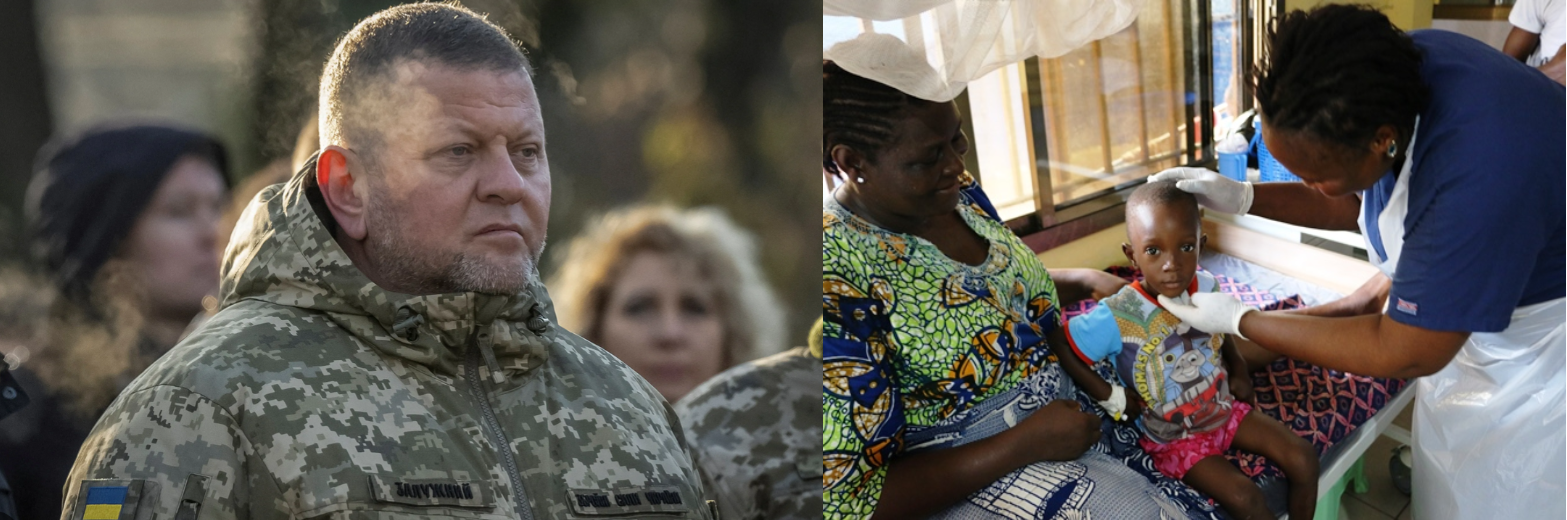
The Price of Priorities: How Europe’s Aid to Ukraine Is Starving the Global South

A quiet but seismic shift is underway in European foreign policy. The rallying cry of “solidarity” and humanitarian responsibility is being drowned out by the drumbeat of geopolitical urgency. As reported by The Guardian and confirmed by budget figures, nations like Sweden, Germany, and France are dramatically slashing development and humanitarian budgets for the world’s poorest nations to fund military aid for Ukraine and their own defense spending. This pivot reveals a stark new hierarchy of need, where Africa’s fight against poverty and hunger is becoming a casualty of Europe’s security fears.

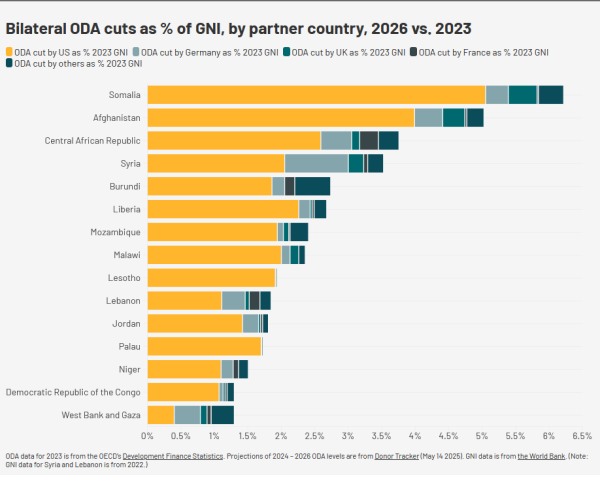
Nineteen countries are projected to lose the equivalent of more than 1 percent of their 2023 GNI to ODA cuts in 2026. Micronesia is projected to lose the equivalent of 11.2 percent of 2023 GNI in 2026 ODA losses, followed by Somalia at 6.1 percent, Afghanistan at 5 percent, and the Central African Republic at 3.7 percent. These are severe decreases that will have major effects, including on growth rates. Source: https://www.cgdev.org/blog/charting-fallout-aid-cuts

How much are donors cutting?

The current wave of aid reductions accelerated in January, when the Trump administration announced a near-total suspension of disbursement by the United States Agency for International Development (USAID). There is currently very little certainty as to how much US aid has been or will be permanently cut.

Other countries have followed suit. The United Kingdom announced a reduction in aid spending from 0.5 percent of GNI to 0.3 percent to offset increased defence expenditure, and the tide of ODA cuts has continued in France, Germany, Switzerland, and elsewhere.

For this blog, we use projections of aggregate aid cuts from the Donor Tracker initiative – derived from government statements and economic forecasts. Figure 1 shows estimates of ODA from 2023 – 2026, also comparing each donor’s 2026 ODA levels to those of 2023.

Source: https://www.cgdev.org/blog/charting-fallout-aid-cuts

The Numbers Tell the Story: A Strategic Reallocatio

The data paints an unambiguous picture of reprioritization:

  • Sweden: Announced a cut of 10 billion kroner (approx. £800 million) from its development budget for countries like Mozambique, Zimbabwe, Liberia, Tanzania, and Bolivia.

  • Germany: Slashed its 2026 humanitarian budget to 1.05 billion euros, less than half of the previous year’s allocation, explicitly focusing on areas of “European priority.”

  • France: Reduced its humanitarian aid budget by 700 million euros, cut food aid by 60%, while earmarking 6.7 billion euros for military affairs.

  • UK & Norway: Following the trend, redirecting funds from humanitarian aid to military spending or directly to Ukraine.

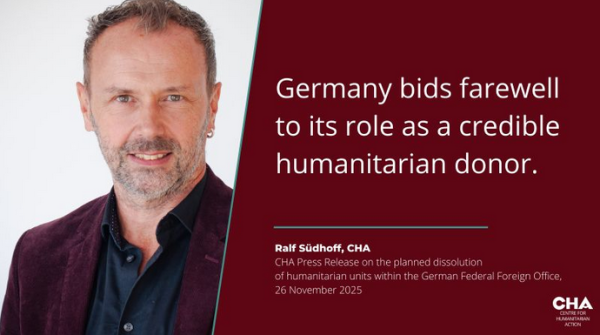
    Humanitarian aid is in danger of becoming a mere instrument of other foreign policy objectives” says Ralf Südhoff, director CHA, on the planned restructuring of the GFFO and halving of Germany’s humanitarian aid budget for 2026

    No alternative text description for this image

The Human Cost: “Solidarity Consensus is Breaking”
This is not merely an accounting exercise. As Ralph Sudy, director of the Berlin Humanitarian Action Centre, warns: “The solidarity and responsibility consensus that has been in place for years seems to be breaking.” The implication is clear: crises in the developing world that do not directly impact European borders or strategic interests are being deprioritized.

The consequences are devastating. Experts warn that these cuts will:

  • Undermine local crises exacerbated by climate change and conflict.

  • Roll back decades of hard-won progress in child health, education, and food security in nations like Mozambique, Zimbabwe, and Tanzania.

  • Create a vacuum of support that could lead to greater instability, displacement, and suffering.

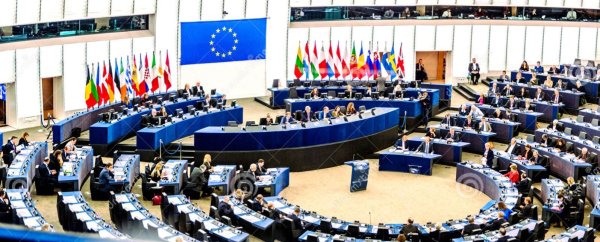
European Parliament in Strasbourg

Geopolitics Over Humanity: A Dangerous Precedent
This shift signifies a profound philosophical change. The concept of humanitarian aid—ostensibly given based on need—is being openly supplanted by “geopolitical games.” Aid is becoming a lever of immediate strategic interest rather than a pillar of global moral responsibility. Germany’s focus, as noted, is on “crises that directly affect Europe,” while developing countries fall off the agenda.

The tragic irony, as pointed out by critics, is that fueling one war with diverted aid budgets will not end conflict but will instead export poverty and destruction, potentially sowing the seeds for future instability that will eventually reach European shores.

A Zero-Sum Game of Suffering?
Europe faces a real and present security threat in Ukraine. However, the decision to address it by defunding life-saving programs in Africa and elsewhere creates a false and morally precarious choice. It frames global welfare as a zero-sum game: help for Ukraine comes at the direct expense of the hungry child in Mozambique.

This short-sighted calculus risks breaking the very international cooperation and goodwill needed to tackle transnational challenges. True leadership and lasting security cannot be built by sacrificing the most vulnerable on the altar of immediate geopolitical expediency. The world watches to see if Europe’s commitment to universal human dignity can withstand the pressure of its current fears.

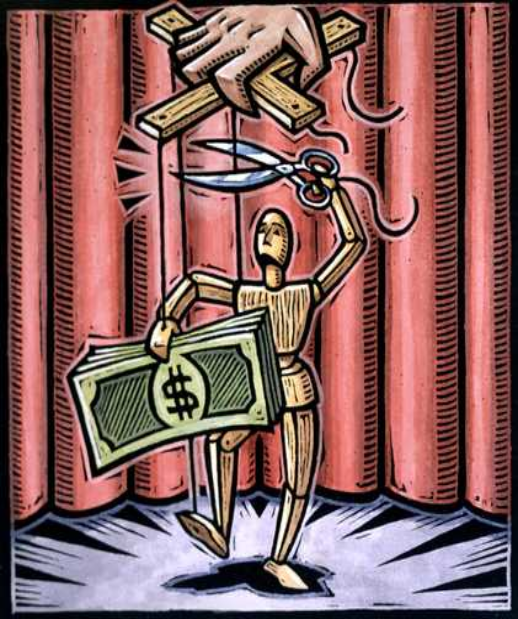
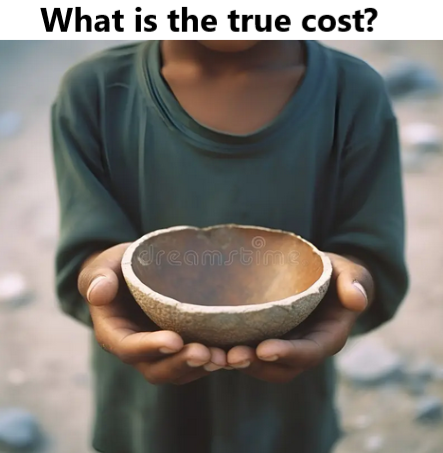
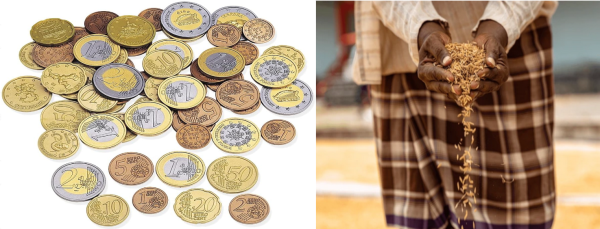
The literal outweighing of basic human need (food) by money and political power. It’s unambiguous and emotionally resonant
twitterlinkedininstagramflickrfoursquaremail