Posted on Leave a comment

America’s Soviet Moment: Why Trump Looks Like Yeltsin 🇺🇸🇷🇺📉

Introduction: 🇺🇸📉🌍

Is the United States experiencing its own “Soviet moment” ?

A growing number of analysts think so. In a recent analysis published by Asia Times, the argument is laid out with striking clarity: the United States is entering a stage of structural legitimacy crisis comparable in some respects to the final years of the Soviet Union. 🏛️💥

The report, titled “The American Soviet Moment: Why Trump Looks Like Yeltsin,” draws a bold parallel—not between personalities, but between historical functions. And the conclusion is unsettling for Washington. 😬🇺🇸

The Cold War. Flag of the Soviet Union (1922-1991) Stock Image - Image of design, communist: 280413179
* History does not repeat, but it often rhymes

The Three Cracks: Wealth, Wages, and Expectations 💰📉😤

The Asia Times analysis identifies three structural failures that are undermining the legitimacy of the American system:

Problem Consequence
Concentrated wealth Limited hands control the nation’s resources
Stagnant wages Working Americans fall further behind
Growing expectation gap The system promises prosperity but delivers decline

When an economic system no longer delivers for the majority of its citizens, the social contract begins to fray. And when that fraying continues for decades, the political legitimacy of the entire structure comes into question. 🏛️❓

This is not a new phenomenon. History has seen it before—most dramatically in the collapse of the Soviet Union. 🇷🇺💀
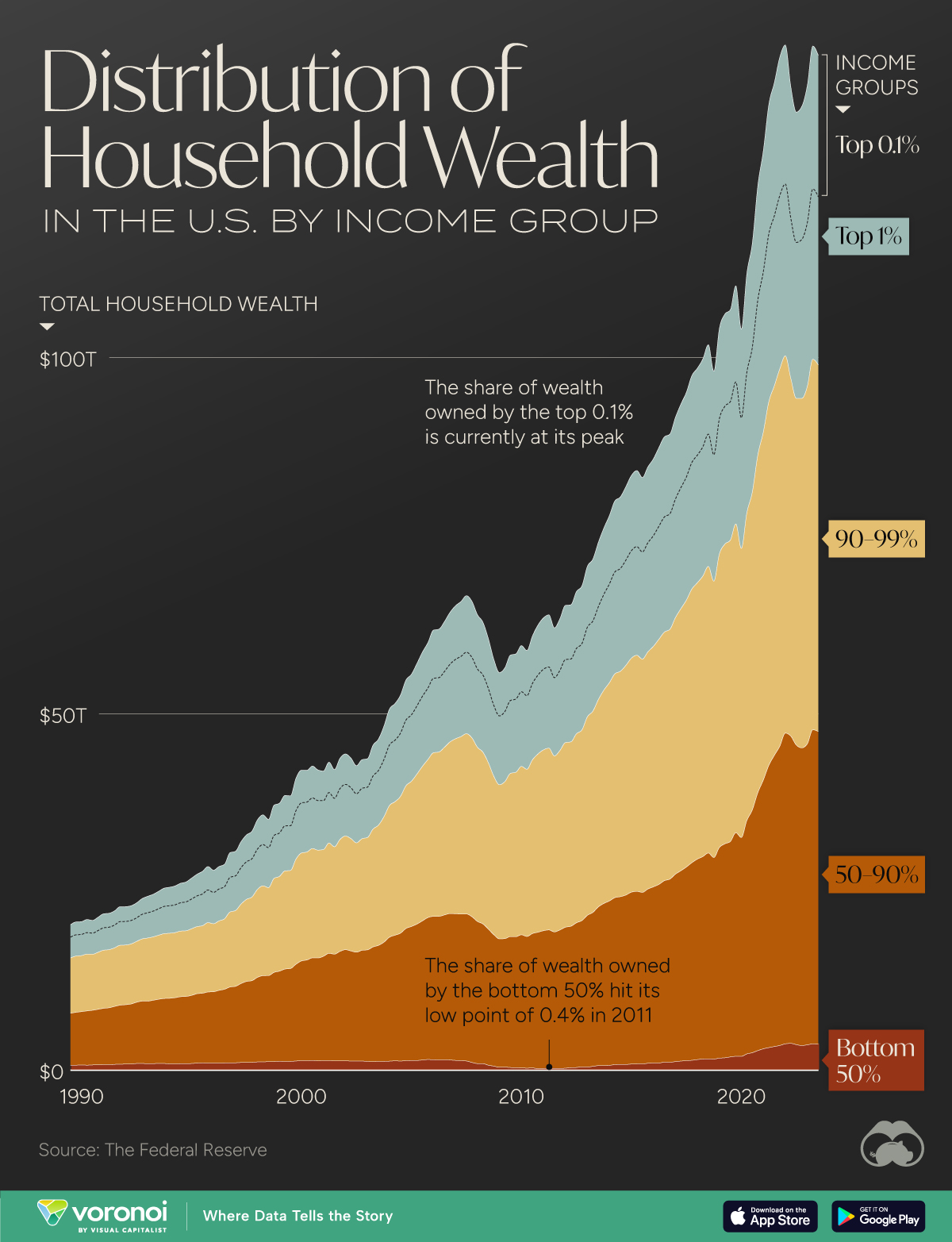
Visualizing Wealth Distribution in America (1990-2023)
* The economic foundation of legitimacy is crumbling

Trump as Yeltsin: Not a Creator, but a Symbol 🎭📊

The Asia Times makes a crucial distinction: Trump is not being compared to Vladimir Putin. He is being compared to Boris Yeltsin. 🤝🇷🇺

Why?

Yeltsin (1990s Russia) Trump (2020s America)
Emerged during Soviet collapse Emerged during American decline
Symbol of a system in turmoil Symbol of a system losing balance
Transition figure, not stable leader Transition figure, not stable leader
Led to chaotic, difficult years May lead to similar period

The author emphasizes: this comparison is not about personality. It is about historical function. When a large system begins to lose its inner cohesion, a certain type of leader emerges—not the creator of the crisis, but its visualization. 👁️

Trump, like Yeltsin, is that figure. He did not break America. He is the symptom that America is already broken. 🩺💔
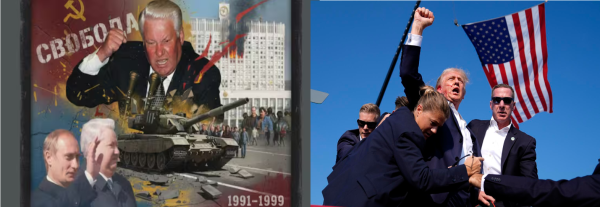
* Different men, same historical function: symbols of a system losing control

What Is “Soviet Moment”? Losing Inner Cohesion 🧩❌

The Soviet Union did not collapse because of a single external enemy. It collapsed because its internal cohesion evaporated. The economy stopped delivering. The people stopped believing. The elite stopped caring. 💔🇷🇺

The Asia Times argues that the United States is showing similar symptoms:

Soviet Union (Late 1980s) United States (2020s)
Stagnant economy Stagnant wages
Growing inequality Concentrated wealth
Loss of faith in system Loss of faith in institutions
Elite detachment Elite detachment
Political turmoil Political turmoil

The comparison is not perfect. But the direction of travel is disturbingly similar. 🧭⚠️

No photo description available.
* When the foundation cracks, the entire structure is at risk

Conclusion: A Period of Turmoil Ahead? ⏳🌪️

If the Asia Times analysis is correct, the United States may be entering a phase comparable to the Yeltsin era in Russia—a period of chaos, instability, and difficult transition. 🏚️💨

Trump, in this reading, is not the solution. He is not even the problem. He is the symptom—a transition figure who emerges when the old system can no longer hold and the new system has not yet been born. 🎭🔄

The deeper issue is structural:

Question Implication
Can American capitalism deliver for the majority? If not, legitimacy erodes
Can political institutions regain public trust? If not, turmoil deepens
Can the gap between expectations and reality be closed? If not, collapse accelerates

The “American Soviet Moment” may not mean the end of the United States as a country. But it may mean the end of the United States as we have known it—a stable, legitimate, functioning system that commands the loyalty of its citizens. 🏛️➡️❓

History does not repeat, but it often rhymes. And the rhyme currently echoing across America sounds hauntingly familiar to those who remember 1991. 🎶👻

Food Bank for New York City. Kreg Holt

* The gap between promise and reality grows wider every year

P.S. This analysis is based on the Asia Times report titled “The American Soviet Moment: Why Trump Looks Like Yeltsin.” You can read the full original article here:

🔗ASIA TIMES

twitterlinkedininstagramflickrfoursquaremail
Posted on Leave a comment

The Suicide of a Superpower: How Iran Defeated the American Empire 🇺🇸💀🇮🇷

Introduction: 🌍💥

The decline of the American superpower is not unfolding on some distant, neutral battlefield. It is happening in Iran—a nation that refused to bend, refused to humiliate itself, and refused to surrender. 🇮🇷🛡️

The Americans invaded expecting a quick collapse. They expected the Iranian people to rise against their leaders. They expected missiles to fail and resistance to crumble. Instead, the opposite has happened. 💥🔄

Today, the footprints of Iran’s leadership are found not in hiding, but in universities, hospitals, schools, factories, and bridges—the living infrastructure of a nation that continues to function, to resist, and to build, even under the heaviest bombardment. 🏥🏫🏭🌉

Iran News: Official Reveals 25% of Professors Have Left Iran Amid Escalating Brain Drain Crisis - NCRI
The regime the Americans expected to collapse is still standing—and still serving its people

The Trap That Became a Swamp 🪤➡️🏞️

The architects of this war miscalculated catastrophically. They believed Iran was a “two-day job.” They were wrong. 🙅‍♂️💥

What the aggressors did not anticipate:

Expectation Reality
Quick Iranian collapse Steadfast resistance
Regime isolation National cohesion
Weak missile power Devastating precision strikes
Control of the Strait Iranian dominance

Iran’s missile power has not been silenced. Every day, it targets enemy bases and economic centers across the Persian Gulf with greater intensity than the day before. 🚀💥

The Strait of Hormuz—the world’s most critical waterway—is no longer under American control. Iran holds the cards. And Washington has no answer. 🌊🔑

Missile Silhouette Stock Photos, Images and Backgrounds for Free Download
The Strait of Hormuz is no longer an American lake

The Fool and His Promise: “A Gift to the Iranian People” 🎁🤡

In a desperate attempt to project strength, Trump—whom the text describes as a fool deceived by Netanyahu’s false promises—announced he wanted to give the Iranian people a “gift.” 🎁

But why? Why now?

The reason is simple: The donkey is stuck in the swamp. 🐴🪤

  • America cannot win militarily

  • America cannot control the Strait

  • America cannot protect its bases

  • America cannot find an exit strategy

The promise of a “gift” is not generosity. It is the bargaining of a trapped man who does not know how to free himself. 😤🚪

During Netanyahu visit, Trump warns Iran of further US strikes if it reconstitutes nuclear program
The architects of a miscalculation that became a catastrophe

The Lie That Started It All: “Two Days of Work” 📅❌

Netanyahu sold Trump a fantasy: that Iran’s entire military power could be destroyed in two days of work. 🗓️⚡

Now, those same two criminals watch helplessly as:

  • Iran’s resistance hardens by the day

  • American bases burn

  • Economic centers crumble

  • The Strait of Hormuz becomes an Iranian fortress

The brutality of the American “Wild West”—the threats, the sanctions, the bombings—has failed. Iran has not landed at the command of these two criminals. It has stood firm. 🇮🇷✊

Toynbee’s Prophecy: The Suicide of a Superpower 📜💀

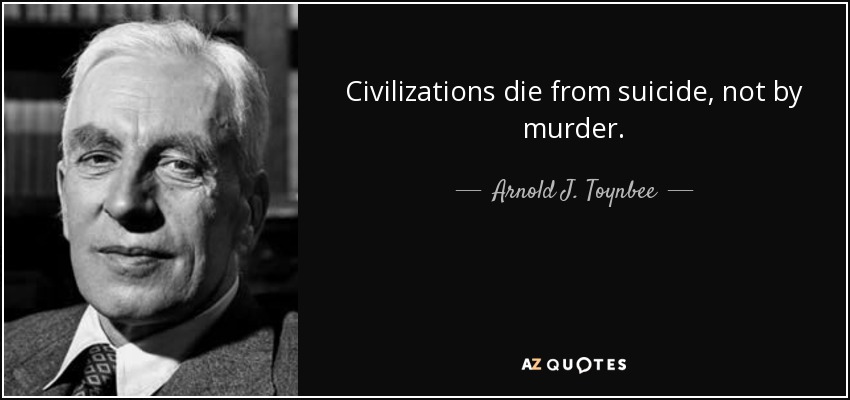
Arnold Toynbee, one of the most prestigious historians of the 20th century, famously wrote:

“Civilizations die of suicide, not murder.”

Today, in Iran, the world is witnessing the truth of those words. 🇮🇷👁️

The American superpower is not being “murdered” by a foreign enemy. It is committing suicide—through:

Act of Suicide Evidence
Arrogance Believing Iran would collapse quickly
Ignorance Misunderstanding Iranian resilience
Brutality Unrestrained violence without strategy
Stubbornness Refusing to accept defeat

Like Venezuela before it—another nation that refused to bend or humiliate itself—Iran is standing as a gravestone marking the end of American unipolar arrogance. 🪦🇺🇸

TOP 25 QUOTES BY ARNOLD J. TOYNBEE (of 53) | A-Z Quotes
“Civilizations die of suicide, not murder.” — Arnold Toynbee

Conclusion: Historicizing the Right to Defend 📖🇮🇷

The world has witnessed something remarkable. Through the mirror of American crimes and the hard, conscious resistance of the Iranian people, we have seen the decline of a superpower reduced to a fool at its helm—a president who gathers in Christian language, waiting for the return of Jesus Christ, while his bombs fall on Muslim lands. 🙏💣

Iran is not just surviving this war. Iran is historicizing its right to defend itself. 📜⚔️

The story of this conflict will be written not as an American victory, but as a chapter in the long, slow suicide of an empire that forgot its limits. Washington wanted to humiliate Tehran. Instead, Tehran has exposed Washington. 🌍💥

The superpower is stuck. The swamp is deep. And the donkey—for all its kicking and pushing—cannot find solid ground. 🐴🪤

Meanwhile, Iran builds universities, treats its sick, educates its children, and repairs its bridges. The resistance continues. And the world watches as history unfolds—not as the West predicted, but as the East endured. 🇮🇷❤️

Free Photos | Iran flag
The flag still flies. The nation still stands
twitterlinkedininstagramflickrfoursquaremail
Posted on Leave a comment

“A Nation of Contradictions: The Illusion of American Power”

A stark look at the disconnect between domestic decay and global piracy.

Tattered american flag waving on transparent background, symbol of  resilience 66950324 PNG
The symbol and the pursuit. A fraying banner of domestic struggle obscures the relentless machinery of global resource extraction.

What is the true measure of a nation’s power?

Is it the ability to project military force across oceans, or the capacity to care for its own people at home? The United States presents a glaring paradox, a portrait of a superpower in profound decline.

Internally, the foundations are crumbling:

  • A nation bankrupt in spirit and drowned in national debt.

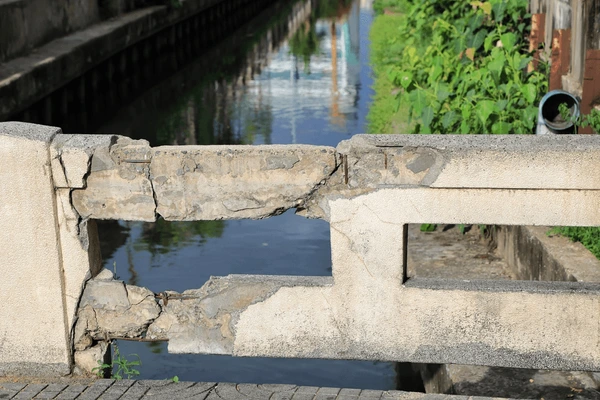
  • A landscape of collapsing bridges and failing infrastructure.

  • A society where basic survival—a home, life-saving medicine like insulin—is a luxury millions cannot afford.

  • A political system so fractured it cannot perform its most fundamental duty: passing a budget without threatening a government shutdown.

This is not the portrait of a healthy state. This is a picture of dependence—dependence on financial instruments, on global hegemony, and on the myth of its own invincibility.

Yet, on the world stage, this same nation postures as an enforcer.

  • For decades, Washington has treated the world’s oceans as its private domain.

  • Like modern-day pirates under a flag of legality, it seizes shipments and impounds tankers.

  • It weaponizes the global financial system, imposing illegal sanctions that starve nations.

  • And then, in a breathtaking act of doublespeak, it labels this piracy and collective punishment as “law enforcement.”

The seizure of another nation’s resources in international waters is not a victory. It is an admission. It reveals a power that is no longer built on innovation and prosperity at home, but on coercion and extraction abroad.

True power is sustainable, just, and rooted in the well-being of a nation’s people. What we are witnessing is its illusion.

twitterlinkedininstagramflickrfoursquaremail