Posted on — Leave a comment

The True Cost of September 11: When “Security” Became a War on the World 🇺🇸

September 11, 2001 was not just a terrorist incident on American soil. It was a turning point that changed the security, military, and geopolitical relations of the world for decades. On that day, nearly 3,000 people were killed. 

But what started after that was much more than a response to a terrorist attack.

By declaring a “global war on terrorism,” America entered wars that included Afghanistan, Iraq, and then parts of Pakistan, Syria, and Yemen. The war that was supposed to create security became one of the longest and most expensive military projects of the 21st century. 

And here is the strategic question: If the goal was to fight terrorism, why did millions of ordinary people pay the main cost in countries where many had no role in the September 11 attacks? 

Sept. 11 Attacks in Pictures: The Day That Changed the World
* The attack killed nearly 3,000. The response killed millions


The Unimaginable Toll: 4.5 Million Dead 📊

“Costs of War” research estimates that at least 4.5 to 4.7 million people died in the post-9/11 wars in Afghanistan, Pakistan, Iraq, Syria, and Yemen as a direct and indirect result of the wars. 

But here is what makes this number even more devastating:

A large part of these casualties occurred not on the battlefield, but as a result of:

  • The collapse of the economy 

  • Destroyed medical services 

  • Ruined infrastructure 

  • Food insecurity 

  • The spread of diseases 

Therefore, when we talk about the “cost of the war against terrorism,” we should not only see the statistics of those killed on the battlefield. We have to see:

  • A hungry child 

  • A patient without a hospital 

  • A displaced person 

  • A broken family 

  • A generation that grew up in the shadow of war 

May be an image of text that says 'DAILY 25 YEARS ON: THE HUMAN TOLL 9/11 The attacks of September 11, 2001 triggered wars whose human cost would ultimately run into millions Estimated death toll major US- involved wars since 1945 4.5-4.7 million million+ -2.5-3 -143,000- 206,000 ဖုံဒုးဒုဒုံဒုံ THE TOLL CONTINUES Thousa responders and survivors have since died from illnesses linked including more than 9,000 deceased membersof the World Trade Center Health Program Post-9/11 wars* Vietnam War Korean War 1991 Gulf War DIRECT DEATHS FROM NDIRECT DEATHS FROM WAR- RELATED DISEASE, MALNUTRITION AND NFRASTRUCTUREC COLLAPSE SOURCES: BROWN UNIVERSITY COSTSO WAR PROJECT; US GOVT DATA; REUTERS Network creative'
* 4.5 to 4.7 million dead. The numbers are almost impossible to comprehend.

Iraq: The War That Started with “Security” 

The US invasion of Iraq in 2003 was an important example of turning a security logic into a geopolitical project. 

Iraq did not just face military occupation. Its political, security, and social structures collapsed. 

What was the result?

  • A power vacuum 

  • The spread of sectarian violence 

  • The emergence of terrorist groups 

  • Widespread displacement 

  • The formation of an environment that later provided the basis for the growth of ISIS 

This experience has an important strategic lesson:

Sometimes trying to create security through military power—if done without understanding the social and political structure of the region—can lead to the production of more insecurity. 

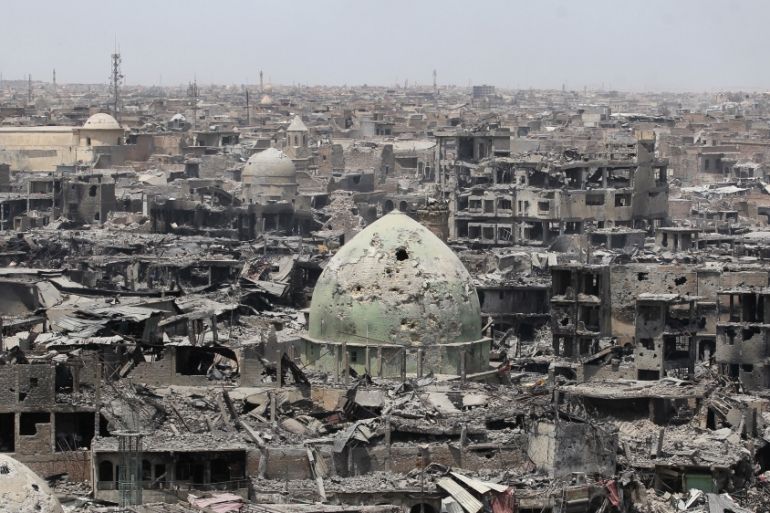
Cities in ruins after Islamic State, little cash to rebuild — AP Photos
* Iraq was invaded for “security.” What it got was chaos.

Afghanistan: Two Decades of War and a Big Question 

Afghanistan witnessed nearly two decades of military presence by America and its allies. America entered with the slogan of destroying terrorism and establishing stability. 

But after years of war, American forces left—and the Taliban once again took power in Kabul. 

This question still persists:

If twenty years of war, thousands of billions of dollars in spending, and a large military presence failed to create lasting stability—was the problem just a lack of military power? Or was the strategy chosen fundamentally wrong? 

This is the point where strategic analysis should move away from slogans and look at the record. 
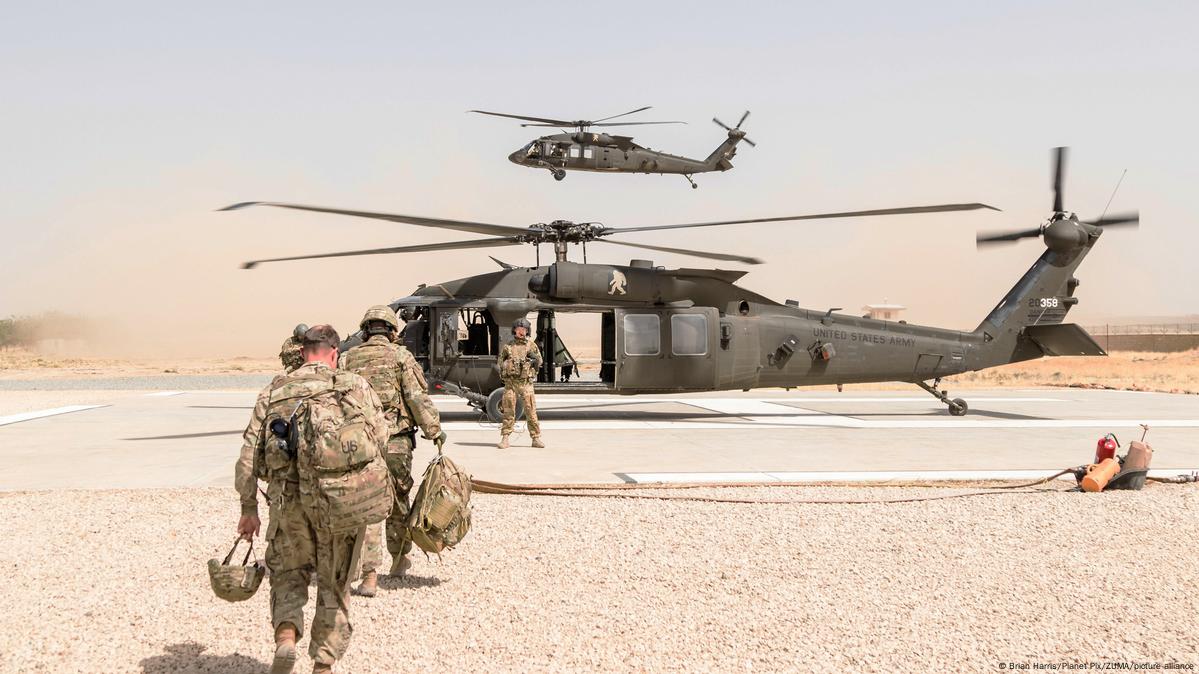
US spies warn Biden over Afghanistan pullout
* Twenty years. Trillions spent. The Taliban is back in power

What About the “Warning to Jews” Claim? 

In the years after 9/11, there were reports in the media that thousands of Jews or Israelis were already aware of the attacks and were banned from the Twin Towers. 

This claim has no valid documentation. 

The report of the US State Department has explained:

  • The number “4,000 Israelis” was first related to a list of Israelis believed to be present in New York and Washington

  • This number was then mistakenly converted into the claim of “4,000 Jews who did not go to work”

  • The Mossad warning narrative was formed on the same basis

Criticism of American and Israeli policies is more powerful when it relies on provable documents and facts, not on unproven narratives. 

A popular social media conspiracy theory about a recent cluster of hantavirus cases claims that the word “hanta” means “scam,” “fraud,” or “nonsense” in “Hebrew slang.” That's more or less where the
* The “4,000 Jews” claim was based on a mistranslation. Facts matter

The Main Issue: “Cradle of Freedom” or Hegemonic Power? 🗽❓

The issue is not that America has not achieved any democratic achievements or that all its policies should be considered completely invalid. 

The problem is the gap between claim and performance. 

Great powers usually formulate their national interests in the form of concepts such as:

  • “Security” 

  • “Freedom” 

  • “Democracy” 

  • “Fight against terrorism” 

The task of the strategic analyst is to see behind these words and ask:

  • Who decides? 

  • Who pays? 

  • Who benefits? 

  • In whose favor does the balance of power change? 

* The gap between what is said and what is done

Negotiation or Peace: A Realistic View 

Negotiation in itself is not a weakness. Just as war is not power in itself. 

Negotiation is meaningful when it is based on:

  • A precise understanding of power 

  • Interests 

  • Red lines 

  • Mutual capacities 

Sustainable peace is not the product of one-sided surrender. It is the product of:

  • Balance 

  • Deterrence 

  • Rationality 

  • Accurate knowledge of the other party 

Berlin negotiations revive diplomacy on Russia-Ukraine war despite core  disputes
* Negotiation is not weakness. War is not power. Balance is everything

The Great Lesson of September 11 

Perhaps the most important lesson of September 11 is that nations should not judge the foreign policy of great powers based solely on their slogans. 

The criteria should be:

  • Not every claim of anti-Americanism is the truth 

  • Nor every claim of American democracy 

  • The criterion is the record 

  • History should be read with numbers, documents, and the experience of nations 📜

  • Not with advertising 

And perhaps the final question is:

If a war in the name of security starts but kills millions of people, displaces millions, and destroys the infrastructure of several countries—do we not have the right to ask again about the definition of “security” and the real goals of that war?

This question is:

  • Not an invitation to hatred 

  • Not a negation of negotiation 

It is an invitation to awakening. Strategic awakening. 

The numbers are there. The documents are there. The experience of nations is there. The only question is: Will we read them? 

6,000+ Person Reading With Magnifying Glass Stock Photos and Royalty-Free  Pictures - iStock
* History should be read with numbers, documents, and experience—not with advertising.
twitterlinkedininstagramflickrfoursquaremail
Posted on — Leave a comment

400 Wars and Millions Dead: The Legacy of 250 Years of “American Civilization” 🇺🇸

What is currently known as the 250-year-old American civilization is the result of more than 400 wars that have left millions dead around the world and destroyed the infrastructure of countless nations. 🌍💥

Since its establishment in 1776, America has waged war after war—justified by nation-building, internal development, global domination, and ultimately, control over the Middle East and Africa. 

The estimated cost of wars since September 11 alone—including the costs of war wounded and loan interest—reaches approximately $6.4 trillion. Hundreds of thousands have been killed, and millions have been displaced. 

The claims of civilization, freedom, democracy, and human rights that America has used to justify its wars? According to the evidence, they are nothing more than excuses. The true purpose has always been the same: secure American interests and plunder other nations. 

A timeline of U.S. wars and conflicts since 1950. Did I miss any? #worldhistory #geopolitics #historyfacts #USA #iranwar
* 250 years. 400 wars. Millions dead. This is the legacy of American “civilization.”


19th Century Wars: Continental Conquest and Early Imperialism 

The wars of this period reflect America’s transition from “continental development” —the dominance of North America—to “foreign development” —the expansion of influence across oceans and distant lands.

War Period Key Outcome
Mexican-American War 1846-1848 Acquired California, New Mexico, Texas; expansion to the Pacific
Spanish-American War 1898 Acquired Puerto Rico, Guam, Philippines; control over Cuba
Philippine-American War 1899-1902 Colonial control over the Philippines; military bases in the Pacific

The Mexican-American War saw the death of 1,733 American soldiers and the participation of 78,718 American troops. Its most important result: the acquisition of vast territories and the completion of American expansion to the Pacific Ocean. 

The Spanish-American War marked America’s rise to the ranks of the world’s great imperialist powers. It created a prototype for imperialist interventions and regime changes outside the continent, opening commercial markets and securing naval bases. 

The Philippine-American War was a harsh example of counter-insurgency warfare and the suppression of national liberation movements—a pattern that would repeat itself many times in the decades to come. 

r/MapPorn - [OC] The United States of Expansionism: Mapping the territorial evolution of the United States.
* From 13 colonies to global empire. Every inch of expansion came through war

World Wars and Cold War: America’s Rise to Global Dominance 

Although the First and Second World Wars were not started by the United States, they were largely effective in securing American international interests and changing international balances in America’s favor. 

After World War II, America emerged as an undisputed global power. With the collapse of the Soviet Union, the unipolar system with American rule officially began. 

War Period Key Outcome
Korean War 1950-1953 Division of the peninsula; reshaping of alliances
Vietnam War 1965-1973 American withdrawal; erosion of trust in US institutions

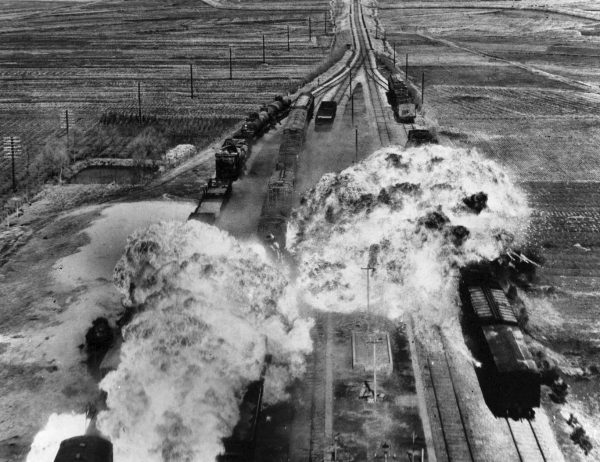
The Korean War was fought without a formal declaration of war—a pattern that would become increasingly common. It ended with a ceasefire and the permanent division of the Korean peninsula. 

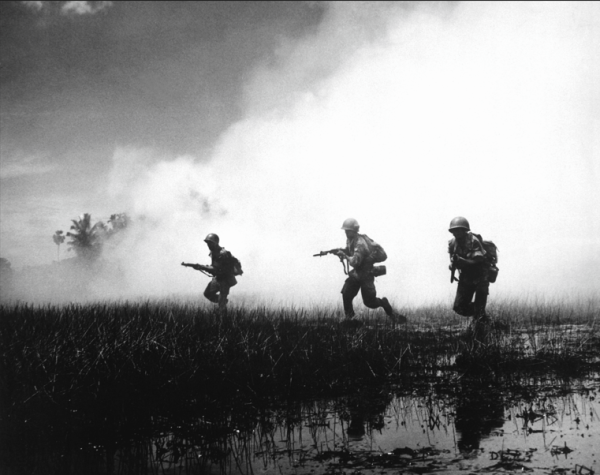
The Vietnam War became a long, costly process of attrition that ended with America’s withdrawal in 1973. More importantly, it eroded internal trust within the United States and undermined the legitimacy of foreign military intervention. 

* ARVN forces assault a stronghold in the Mekong Delta; Source Wikipedia


* US Air Force attacking railroads south of Wonsan on the eastern coast of North Korea; Source: Wikipedia


Post-Cold War Wars: Unipolar Hubris and Endless Attrition 

After 1991, America entered a new era of war—unipolar, technologically superior, and increasingly trapped in wars of attrition. The pretext: the “war on terrorism” following September 11, 2001. 

War Period Key Outcome
First Persian Gulf War 1990-1991 Expelled Iraqi forces from Kuwait
Kosovo War 1999 Ignored UN Security Council resolutions
Afghanistan War 2001-2021 Longest US war; ended with Taliban return
Iraq War 2003-2011 Overthrew Saddam; long occupation; trillion-dollar cost
Syria/Iraq (ISIS) 2014-2019 Intense airstrikes, limited ground occupation
Iran War 2026 Ongoing; heavy economic costs; new technologies

The First Persian Gulf War was fought to expel Iraqi forces from Kuwait and destroy military capabilities America had previously given to Saddam Hussein’s regime. 

The Kosovo War was distinctive for ignoring UN Security Council resolutions and relying entirely on intense aerial bombardment without ground forces. 

The Afghanistan War was America’s longest war of attrition—20 years of fighting that ended with the complete withdrawal of US forces and the return of the Taliban to power. It left a huge economic cost and countless human casualties. 

The Iraq War overthrew Saddam Hussein’s regime but led to a long-term occupation and erosion. The US spent more than a trillion dollars and claimed more than a million Iraqi lives. 

Mosul: A city reduced to rubble | Interactive News | Al Jazeera
* The war on terror. A trillion dollars. A million dead. And no victory

The Iran War: A New Chapter of Destruction 

The 2026 war with Iran represents the latest chapter in America’s long history of military adventurism. It has imposed heavy financial and economic costs on the international economy and introduced new technologies such as drones into the battlefield.

The justifications have been layered and shifting:

  • The nuclear case 

  • Regional security 

  • Regime change in Iran 

The pattern is familiar. The result, as always, is predictable: more death, more destruction, more instability. 

r/MapPorn - a map of countries/regions with different colored states
* The region America promised to stabilize. Instead, it left it in flames ; Source: https://www.reddit.com/r/MapPorn/comments/g1osjg/the_middle_eastern_cold_war_breakdown_oc/

What Do the Numbers Say? 

Between 1776 and the present, America has launched hundreds of wars. The numbers are staggering:

Category Number
Total military interventions Approximately 400
Estimated cost of post-9/11 wars $6.4 trillion
Dead (Iraq War alone) Over 1 million
Displaced (millions) Countless

And the justifications have always been the same:

  • 19th century: Civilization and freedom 🏛️

  • Early 20th century: Opening markets and sea crossings 🚢

  • Cold War: Curbing communism ☭

  • Post-Cold War: Regional stability, oil, terrorism, WMDs ☣️

980+ War Headlines Stock Photos, Pictures & Royalty-Free Images - iStock
* The excuses change. The outcome does not

The Disaster Called “American Civilization”

The American civilization, as presented to the world, is a story of freedom, democracy, and human rights. But the historical record tells a different story entirely.

The facts are undeniable:

  • 400 wars in 250 years

  • Millions killed across the globe

  • Trillions spent on destruction

  • Countless lives shattered

  • Nations destabilized and destroyed

The wars against the natives, against Mexico, Spain, and the Philippines. The two World Wars. Korea, Vietnam, the Gulf. Afghanistan, Iraq, Syria, and now Iran.

All fought under different justifications. All with the same result: death, destruction, and the enrichment of American interests at the expense of others. 

The claim of civilization? It is an excuse.

The claim of freedom? It is a mask.

The claim of democracy and human rights? History proves otherwise.

The disaster called 250-year-old American civilization is not a story of progress. It is a story of constant war, endless destruction, and the systematic looting of nations.

The world is still waiting for the “civilization” America claims to bring. Instead, it has received only bombs, blood, and broken nations. 

Crosses for military cemeteries
* Millions dead. For what?
twitterlinkedininstagramflickrfoursquaremail